Skip to main content
Contents Embed Dark Mode Prev Up Next \(\require{mathtools} \setcounter{MaxMatrixCols}{15}
\newcommand{\N}{\mathbb N}
\newcommand{\Z}{\mathbb Z}
\newcommand{\Q}{\mathbb Q}
\newcommand{\R}{\mathbb R}
\newcommand{\cC}{\mathcal{C}}
\newcommand{\F}{\mathbb{F}}
\newcommand{\GF}{\mathrm{GF}}
\DeclareMathOperator{\Span}{Span}
\DeclareMathOperator{\rank}{rank}
\DeclareMathOperator{\lcm}{lcm}
\DeclareMathOperator{\rk}{rk}
\DeclareMathOperator{\wt}{wt}
\DeclareMathOperator{\im}{im}
\makeatletter
\@ifundefined{char}{
\DeclareMathOperator{\char}{char}
}{}
\makeatother
\DeclareMathOperator{\GRS}{GRS}
\DeclareMathOperator{\RS}{RS}
\DeclareMathOperator{\BCH}{BCH}
\newcommand{\transpose}[1]{#1^{\top}}
\newcommand{\by}{\mathbf{y}}
\newcommand{\bc}{\mathbf{c}}
\newcommand{\bx}{\mathbf{x}}
\newcommand{\bm}{\mathbf{m}}
\newcommand{\bs}{\mathbf{s}}
\newcommand{\be}{\mathbf{e}}
\newcommand{\bu}{\mathbf{u}}
\newcommand{\bv}{\mathbf{v}}
\newcommand{\bh}{\mathbf{h}}
\newcommand{\br}{\mathbf{r}}
\newcommand{\bzero}{\mathbf{0}}
\newcommand{\balpha}{\boldsymbol{\alpha}}
\renewcommand{\vec}[1]{\boldsymbol{#1}}
\newcommand{\lt}{<}
\newcommand{\gt}{>}
\newcommand{\amp}{&}
\newcommand{\fillinmath}[1]{\mathchoice{\underline{\displaystyle \phantom{\ \,#1\ \,}}}{\underline{\textstyle \phantom{\ \,#1\ \,}}}{\underline{\scriptstyle \phantom{\ \,#1\ \,}}}{\underline{\scriptscriptstyle\phantom{\ \,#1\ \,}}}}
\)
Section Week 12
This is an outline of the topics we covered in the twelfth week of class.
Subsection Tuesday 3/31
Upcoming.
Today: How to do GRS decoding
Thursday: Why this worked...
ELP.
\begin{equation*}
\Lambda(x) = \prod_{j \in J}(1 - \alpha_{j} x)
\end{equation*}
EVP.
\begin{equation*}
\Gamma(x) = \sum_{j \in J}e_{j} v_{j} \prod_{m \in J \setminus \{j\}}(1 - \alpha_{m} x)
\end{equation*}
Key equation.
\begin{equation*}
\Lambda(x) S(x) \equiv \Gamma(x) \pmod{x^{d-1}}
\end{equation*}
Extended Euclid Alg:.
\begin{equation*}
q_{i}(x), \ r_{i}(x), \ s_{i}(x), \ t_{i}(x)
\end{equation*}
\(\displaystyle s_{i}(x) a(x) + t_{i}(x) b(x) = r_{i}(x)\)
\(\displaystyle s_{i}(x) x^{d-1}+ t_{i}(x) S(x) = r_{i}(x)\)
Final values:.
\begin{align*}
h&= 2\\
t_{h}&= 8x^{2} + 8 \implies \Lambda = x^{2} + 1 \quad (\text{using }t_{h}(0))\\
r_{h}&= 10x + 6 \implies \Gamma = 11x + 4
\end{align*}
Subsection Thursday 4/2
Coding Theorist of the Day.
Elwyn Berlekamp , 1940-2019
PhD MIT, professor at Berkeley, Bell Labs
Many algorithm innovations (codes, polynomial division, …)
History / Timeline for RS Codes.
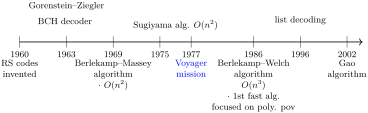
RS codes invented in 1960; some codes could be decoded with Gorenstein-Ziegler BCH decoder in 1963. The Berlekamp-Massey algorithm with complexity
\(O(n^2)\) invented 1969. Sugiyama’s algorithm with the same complexity invented 1975. RS codes were used for the Voyager missions in 1977. In 1986 Berlekamp-Welch was invented with complexity
\(O(n^3)\text{.}\) This was the first fast algorithm focused on the polynomial evaluation point of view. Starting in 1996 Sudan and others create list-decoding algorithms. In 2002 Gao created a fast algorithm for polynomial evaluation point of view.
Figure 41. Timeline of Developments in RS CodesWhy Do They Work.
Proposition 42 .
At step \(i\) of Euclid alg.:
\(\displaystyle s_{i}(x) a(x) + t_{i}(x) b(x) = r_{i}(x)\)
\(\displaystyle \deg(t_{i}) + \deg(r_{i-1}) = \deg(a)\)
\(\displaystyle \gcd(s_{i}(x), t_{i}(x)) = 1\)
Theorem 43 .
For
\(d \in \mathbb{Z}\text{,}\) \(S(x) \in F[x]\) there exists at most one pair of polys
\(\Lambda(x), \Gamma(x)\) s.t.
\(\displaystyle \Lambda(x) S(x) \equiv \Gamma(x) \pmod{x^{d-1}}\)
\(\deg(\Lambda(x)) \le \frac{d-1}{2}\) &
\(\deg(\Gamma(x)) < \frac{d-1}{2}\)
\(\gcd(\Lambda(x), \Gamma(x)) = 1\) &
\(\Lambda(0) = 1\)
Proposition 45 .
Properties of Euclid alg. w/
\(a(x) = x^{d-1}\text{,}\) \(b(x) = S(x)\) give exactly 1), 2), 3) with
\(\Lambda(x) = t_{h}(x) / t_{h}(0)\) and
\(\Gamma(x) = r_{h}(x) / t_{h}(0)\text{.}\)
Example 46 . Worksheet Problem 1 Setup.
\(n=8\text{,}\) \(k=4\text{,}\) \(e=2\text{,}\) \(e+k-1=5\)
\(y_{i} E(\alpha_{i}) = Q(\alpha_{i})\)
\(E(x) = x^{2} + e_{1} x + e_{0}\)
\(Q(x) = q_{0} + q_{1} x + q_{2} x^{2} + q_{3} x^{3} + q_{4} x^{4} + q_{5} x^{5}\)
\(i=1\text{:}\)
\begin{equation*}
0 = q_{0} + q_{1} + q_{2} + q_{3} + q_{4} + q_{5}
\end{equation*}
\(i=2\text{:}\)
\begin{equation*}
0 = q_{0} + 4q_{1} + 3q_{2} + 12q_{3} + 9q_{4} + 10q_{5} = Q(4) = Q(\alpha_{2})
\end{equation*}
\(i=7\text{:}\) \(y_{7} E(\alpha_{7}) = Q(\alpha_{7})\)
\begin{equation*}
3 E(5) = Q(5)
\end{equation*}
\begin{equation*}
3(12 + 5e_{1} + e_{0}) = q_{0} + 5q_{1} + 12q_{2} + 8q_{3} + 9q_{4} + 5q_{5}
\end{equation*}
\begin{equation*}
\begin{bmatrix}1&1&1&1&1&1&0&0 \\&&&&&&&\\&&&A&&&&\\&&&&&&&\\ 1&5&12&8&9&5&10&11\end{bmatrix} \begin{pmatrix}q_{0} \\ q_{1} \\ q_{2} \\ q_{3} \\ q_{4} \\ q_{5} \\ e_{0} \\ e_{1}\end{pmatrix} = \begin{pmatrix}0 \\ 0 \\ 0 \\ 0 \\ 0 \\ 0 \\ 10 \\ 1\end{pmatrix}
\end{equation*}
Worksheet Problem 2 Results
\begin{align*}
Q(x)&= 8x + 4x^{2} + 5x^{3} + 10x^{4} + x^{5}\\
E(x)&= 8 + 9x + x^{2}
\end{align*}