Skip to main content
Contents Embed Dark Mode Prev Up Next \(\require{mathtools} \setcounter{MaxMatrixCols}{15}
\newcommand{\N}{\mathbb N}
\newcommand{\Z}{\mathbb Z}
\newcommand{\Q}{\mathbb Q}
\newcommand{\R}{\mathbb R}
\newcommand{\cC}{\mathcal{C}}
\newcommand{\F}{\mathbb{F}}
\newcommand{\GF}{\mathrm{GF}}
\DeclareMathOperator{\Span}{Span}
\DeclareMathOperator{\rank}{rank}
\DeclareMathOperator{\lcm}{lcm}
\DeclareMathOperator{\rk}{rk}
\DeclareMathOperator{\wt}{wt}
\DeclareMathOperator{\im}{im}
\makeatletter
\@ifundefined{char}{
\DeclareMathOperator{\char}{char}
}{}
\makeatother
\DeclareMathOperator{\GRS}{GRS}
\DeclareMathOperator{\RS}{RS}
\DeclareMathOperator{\BCH}{BCH}
\newcommand{\transpose}[1]{#1^{\top}}
\newcommand{\by}{\mathbf{y}}
\newcommand{\bc}{\mathbf{c}}
\newcommand{\bx}{\mathbf{x}}
\newcommand{\bm}{\mathbf{m}}
\newcommand{\bs}{\mathbf{s}}
\newcommand{\be}{\mathbf{e}}
\newcommand{\bu}{\mathbf{u}}
\newcommand{\bv}{\mathbf{v}}
\newcommand{\bh}{\mathbf{h}}
\newcommand{\br}{\mathbf{r}}
\newcommand{\bzero}{\mathbf{0}}
\newcommand{\balpha}{\boldsymbol{\alpha}}
\renewcommand{\vec}[1]{\boldsymbol{#1}}
\newcommand{\lt}{<}
\newcommand{\gt}{>}
\newcommand{\amp}{&}
\newcommand{\fillinmath}[1]{\mathchoice{\underline{\displaystyle \phantom{\ \,#1\ \,}}}{\underline{\textstyle \phantom{\ \,#1\ \,}}}{\underline{\scriptstyle \phantom{\ \,#1\ \,}}}{\underline{\scriptscriptstyle\phantom{\ \,#1\ \,}}}}
\)
Section Week 1
This is an outline of the topics we covered in the first week of class.
Subsection Tuesday 1/13
Coding Theorist of the Day.
Richard Hamming , 1915-1998
At Bell Labs during major works on early computers and coding theory
Introduced error-correcting codes in 1950
Helped develop early programming languages
“The purpose of computing is insight, not numbers.”
On Tuesday we got to know each other and discussed my teaching philosophy and the course structure. We then began to work on
Introduction to Codes to start to get a feel for what a code is and how we can use codes to detect and correct errors in transmitted messages. Finally, we discussed some scenarios where error-correcting codes are useful:
Data over TCP/IP: detection only
Data over radio/satellites/cell towers: detection and correction
Data over time instead of distance (e.g. storage): detection and correction
CDs, DVDs, Blu-Rays to handle scratches
bar codes and QR codes to handle damage
Subsection Thursday 1/15
Coding Theorist of the Day.
Claude Shannon , 1916-2001
Cryptography in WWII, foundations of symmetric key cryptography
Foundations for information theory in 1948, coined the term “bit”
Built one of the first AI devices, the “Theseus” maze-solving mouse
Claude LLM is named after him
Questions and observations:.
Does error detection give position? Sometimes.
Is
\(d(C) \geq 2\text{?}\) Yes.
How does Hamming distance work if not binary code? The same way.
Is dimension
\(k\) an integer? In general, no.
\begin{equation*}
C=\{1000,1111,1001\}
\end{equation*}
Is
\(d_H\) a metric? Yes.
\(d_H(u,v) \ge 0\) and \(d_H(u,v) = 0 \iff u = v\)
\(\displaystyle d_H(u,v) = d_H(v,u)\)
\(d_H(u,v) \le d_H(u,w) + d_H(w,v)\) (Triangle inequality)
Definitions.
Definition 4 . t-error correcting code.
A
\(t\) -error correcting code is a code for which there exists a decoding algorithm such that any pattern of
\(t\) errors in the channel can be recovered.
Definition 5 . t-error detecting code.
A
\(t\) -error detecting code is a code for which there exists a decoding algorithm such that any pattern of up to
\(t\) errors in the channel can be detected.
Decoding.
Definition 6 . Maximum likelihood decoding.
Given a received word
\(y\text{,}\) return
\(x \in C\) most likely to have been sent.
Definition 7 . Nearest neighbor decoding.
Given
\(y\text{,}\) return
\(x \in C\) with
\(d(x,y)\) minimized.
In nice channels, these are equivalent.
Proposition 1.4.2.
Proposition 8 . Relation Between Minimum Distance and Error-Correcting Capability.
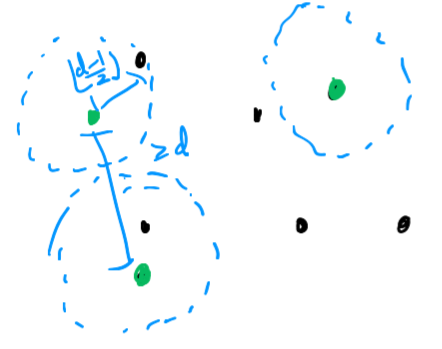
For a code \(C\) with minimum distance \(d\text{,}\) the following are equivalent:
\(C\) has minimum distance \(d\text{.}\)
\(C\) can correct up to \(\lfloor (d-1)/2 \rfloor\) errors.
\(C\) can detect up to \(d-1\) errors.
Definition 9 . Hamming sphere.
A sphere (or ball) of radius
\(r\) in the Hamming metric around
\(x\in \Sigma^n\) is:
\(B_r(x) = \{ y \in \Sigma^n \mid d_H(x,y) \le r \}\text{.}\)