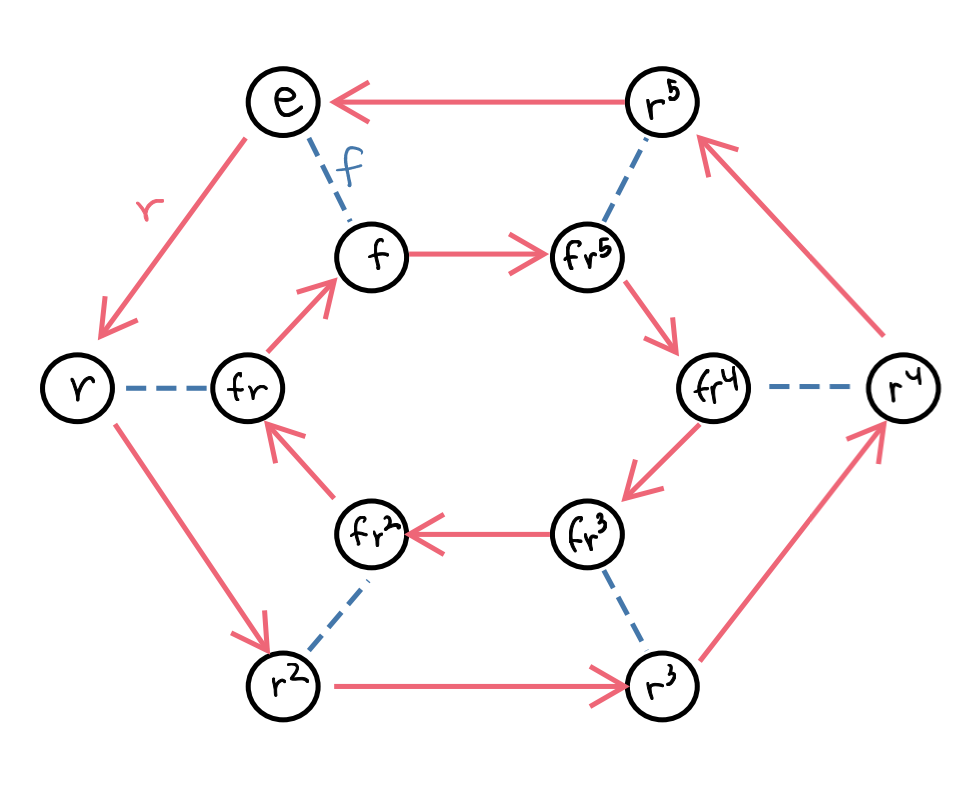
First any such set must contain at least one reflection, since any set of rotations generates at most the subgroup of rotations. It must not contain as a subset any two element generating set, all of which are listed in the previous two parts. So it cannot contain either
\(r\) or
\(r^5\) and it cannot contain any pair of reflections over adjacent axes (i.e. any of the pairs of reflections that generate the whole group).
First, let’s find the minimal generating sets containing two rotations and one reflection, if such exist. By the argument we outlined in (b), we cannot generate \(r\) from any one reflection and only \(r^2\) and \(r^4\text{,}\) but \(\{r^2,r^3,s\}\) and \(\{r^4,r^3,s\}\) for any reflection \(s\) both work, since \((r^3)(r^2)^2=r=(r^3)(r^4).\) So there are twelve minimal generating sets containing two rotations and one reflection.
\begin{align*}
\amp \{r^2, r^3, f\}, \{r^2, r^3, fr\}, \{r^2, r^3, fr^2\} \\
\amp \{r^2, r^3, fr^3\}, \{r^2, r^3, fr^4\}, \{r^2, r^3, fr^5\} \\
\amp \{r^4, r^3, f\}, \{r^4, r^3, fr\}, \{r^4, r^3, fr^2\} \\
\amp \{r^4, r^3, fr^3\}, \{r^4, r^3, fr^4\}, \{r^4, r^3, fr^5\} \text{.}
\end{align*}
Now, consider minimal generating sets containing one rotation and two reflections. Since we can get \(r\) if we have both \(r^3\) and either \(r^2\) or \(r^4\text{,}\) we need one of these three rotations and a pair of reflections that generate one from the other set. By the argument of the last part this gives the following sets:
\begin{align*}
\amp \{r^3, f, fr^2\}, \{r^3, fr^2, fr^4\}, \{r^3, fr^4, f\} \\
\amp \{r^3, fr, fr^3\}, \{r^3, fr^3, fr^5\}, \{r^3, fr^5, fr\} \\
\amp \{r^2, f, fr^3\}, \{r^2, fr, fr^4\}, \{r^2, fr^2, fr^5\} \\
\amp \{r^4, f, fr^3\}, \{r^4, fr, fr^4\}, \{r^4, fr^2, fr^5\} \text{.}
\end{align*}
Finally, we consider if there are any minimal generating sets containing three reflections. To generate with only reflections, we must have a pair as in part (c), but this will then not be a minimal generating set. So no such generating sets exist.