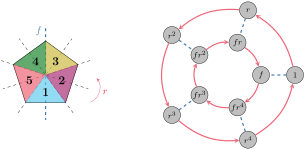
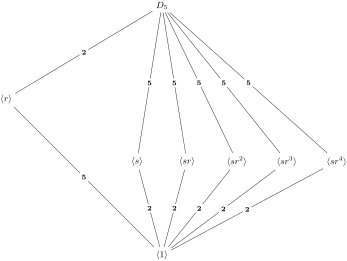
First, all of the normal subgroups of \(D_5\) are in their own conjugacy class, so \(\{1\}, \subgroup{r}, D_5\) are each in their own conjugacy class. Then the size two subgroups generated by a reflection are all conjugate because we have
\begin{equation*}
r^j(f)r^{-j} = fr^{-j}r^{-j}=fr^{-2j}
\end{equation*}
and we can choose \(j\) to get any value of \(-2j\bmod 5\text{,}\) so all of the reflections subgroups are conjugate to \(\subgroup{f}\) and hence to each other. Explicitly,
\begin{equation*}
rfr^{-1}=fr^3, r^2fr^{-2}=fr, r^3fr^{-3}=fr^4, r^4fr^{-4}=fr^2.
\end{equation*}
Thus the conjugacy classes of \(D_5\) are:
\begin{gather*}
\{\subgroup{1}\}, \\
\{\subgroup{r}\}, \\
\{\subgroup{f},\, \subgroup{fr},\, \subgroup{fr^2},\, \subgroup{fr^3}, \subgroup{fr^4}\}, \\
\{D_5\}.
\end{gather*}