Instructions: You may type up or handwrite your work, but it must be neat, professional, and organized and it must be saved as a PDF file and uploaded to the appropriate Gradescope assignment. Use a scanner or scanning app to convert handwritten work on paper to PDF. I encourage you to type your work using the provided template.
All tasks below must have a complete solution that represents a good-faith attempt at being right to receive engagement credits. If your submission is complete and turned in on time, you will receive full engagement credit for the assignment. All other submissions will receive zero engagement credit. Read the guidelines at Grading Specifications carefully.
To abide by the class academic honesty policy, your work should represent your own understanding in your own words. If you work with other students, you must clearly indicate who you worked with in your submission. The same is true for using tools like generative AI although I strongly discourage you from using such tools since you need to build your own understanding here to do well on exams.
For these problems a justification is not required for credit, but it may be useful for your own understanding to include one. True/False problems should be marked True if the statement is always true, and False otherwise. Multiple choice problems may have more than one correct answer if that is indicated in the problem statement; be sure to select all that apply. Fill-in problems require a short answer such as a number, word, or phrase.
False. There are various subgroups of \(S_{n+1}\) which are isomorphic to \(S_n\text{,}\) but permutations of the numbers \(\{1,\dots,n\}\) are a different set of functions than permutations of the numbers \(\{1,\dots,n+1\}\text{.}\)
By the Fundamental Theorem of Cyclic Groups, \(\Z_{20}\) has six subgroups, of orders \(1,2,4,5,10\text{,}\) and \(20\text{.}\) They are generated by \(0, 10, 5, 4, 2\text{,}\) and \(1\) respectively:
Problem Specs/Notes: For a Success on this problem you need to justify how you found the generators and subgroups for each part and correctly identify at least 80% of them.
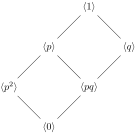
Determine the subgroup lattice for \(\Z_{p^2q}\text{,}\) where \(p\) and \(q\) are distinct primes. Be sure to show the work supporting the lattice you draw.
Because the subgroups of a cyclic group only depend on the divisors of \(n\text{,}\) the subgroups here have orders \(1,p^2, pq, p, q,\) and \(p^2q\text{.}\) This is the same structure as \(\Z_{20}\) in the previous problem, where \(p=2, q=5\text{.}\) The lattice is below.
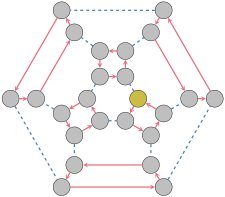
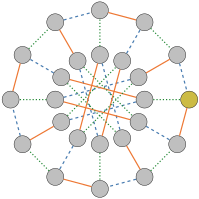
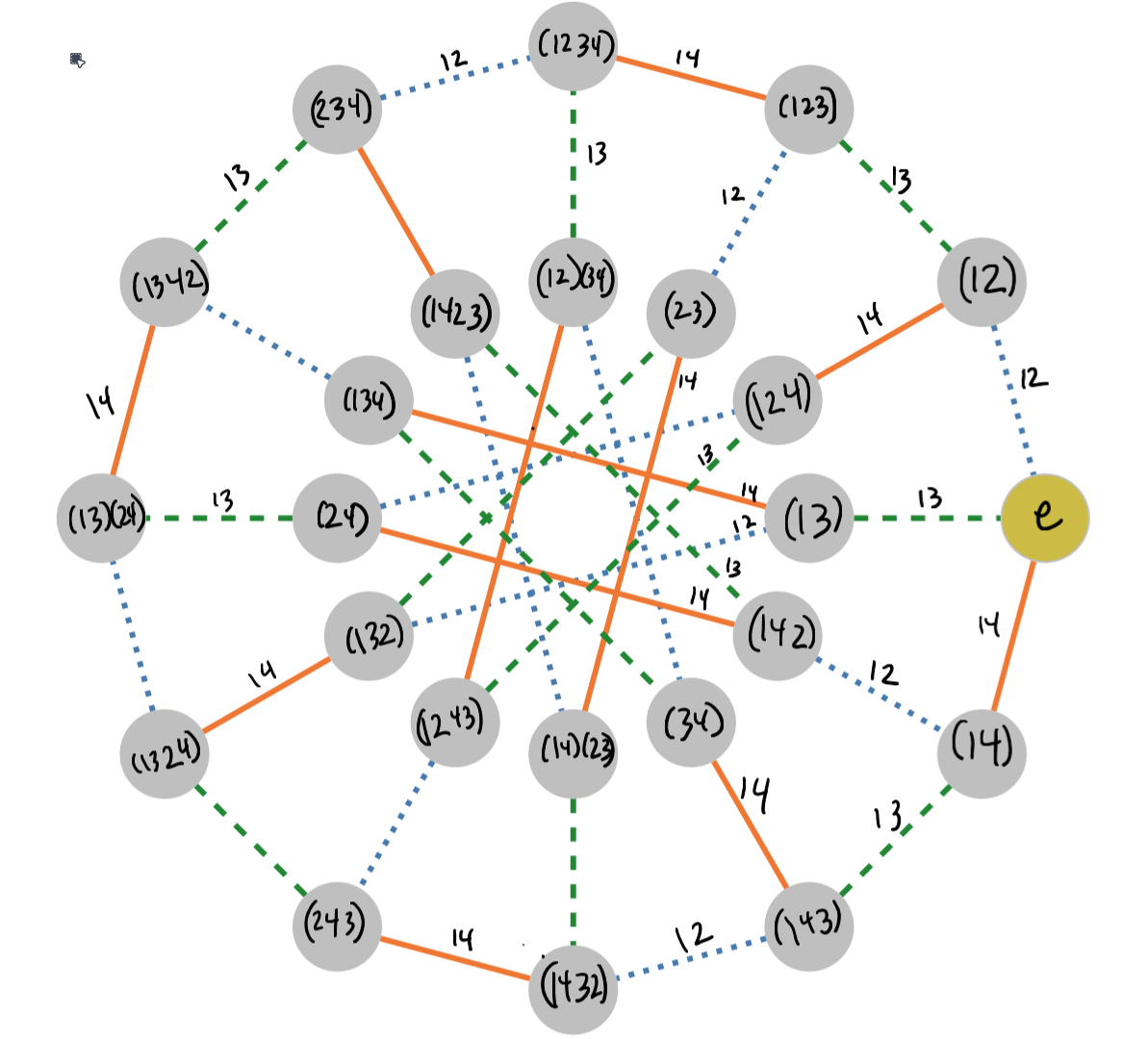
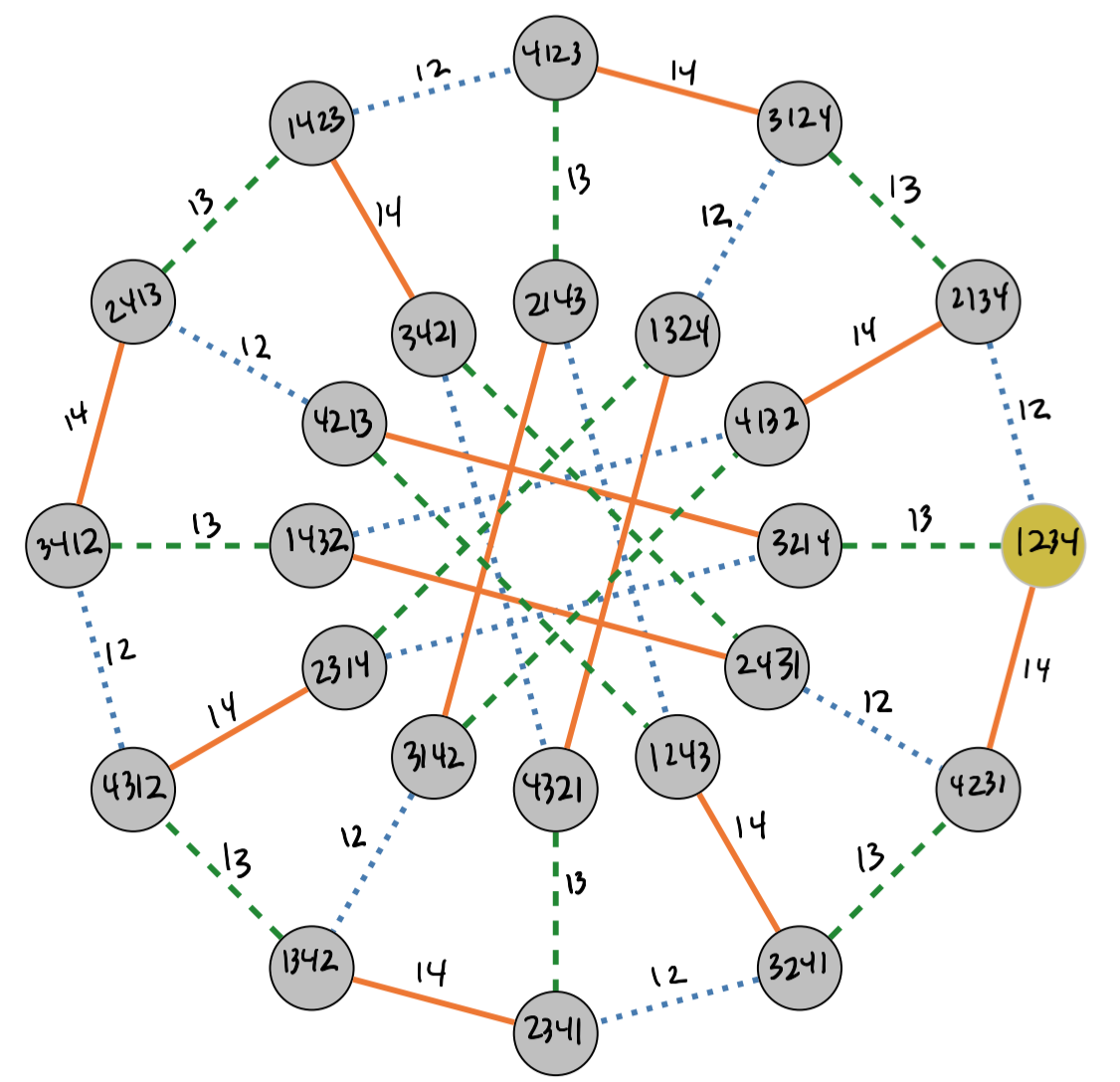
On the Nauru graph, label the nodes with permutations of the word \(\mathbf{1234}\text{,}\) where \((i\;j)\) swaps the \(i^{\rm th}\) and \(j^{\rm th}\)coordinates.
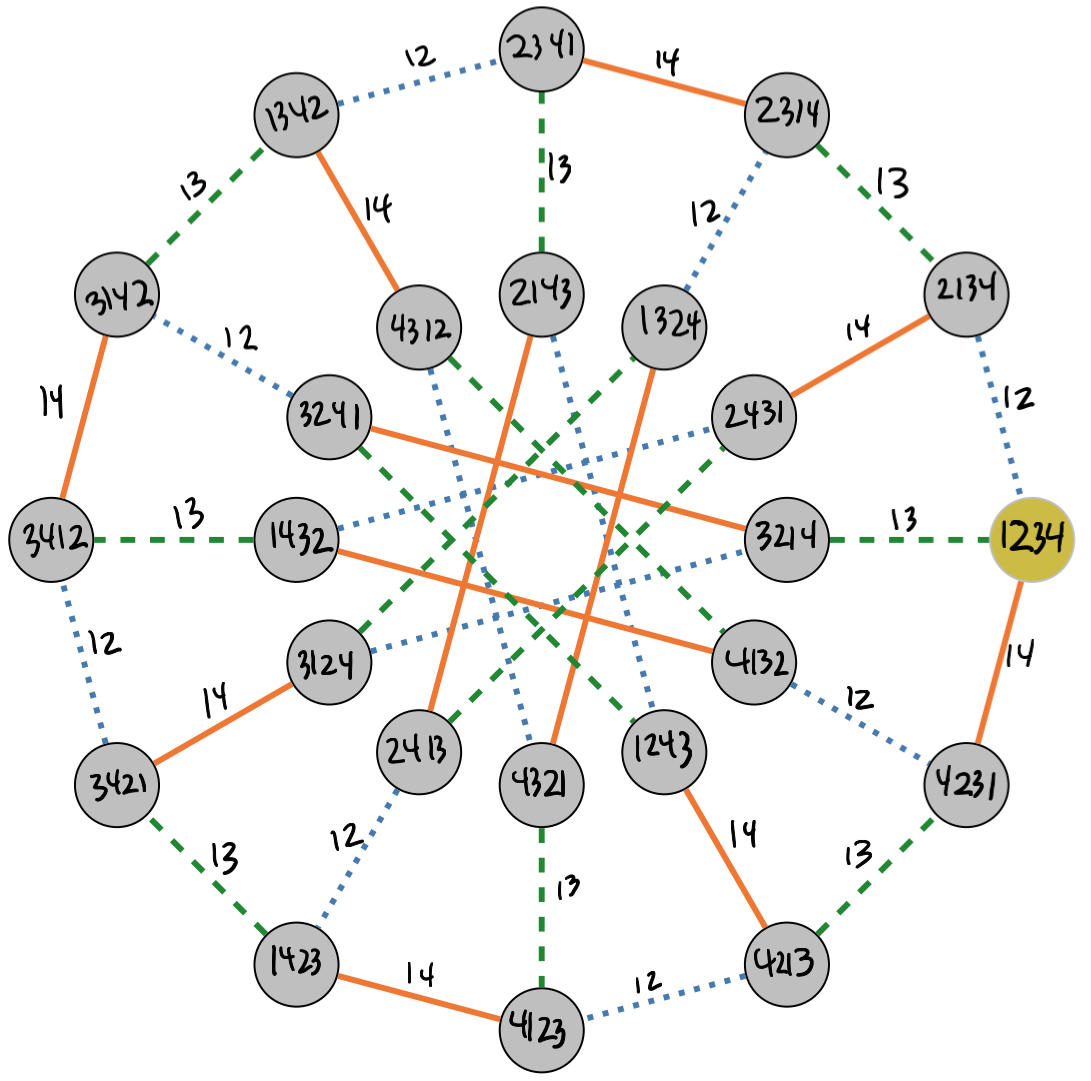
On a separate copy of the Nauru graph, label the nodes with permutations of \(\mathbf{1234}\text{,}\) where \((i\;j)\) swaps the numbers\(i\) and \(j\text{.}\)
Problem Specs/Notes: This problem needs all four Cayley diagrams produced with at most 2 incorrect labels on vertices in any one diagram for a Success.
7.[Optional Challenge]: Generating Set from a Cayley Diagram of \(S_4\).
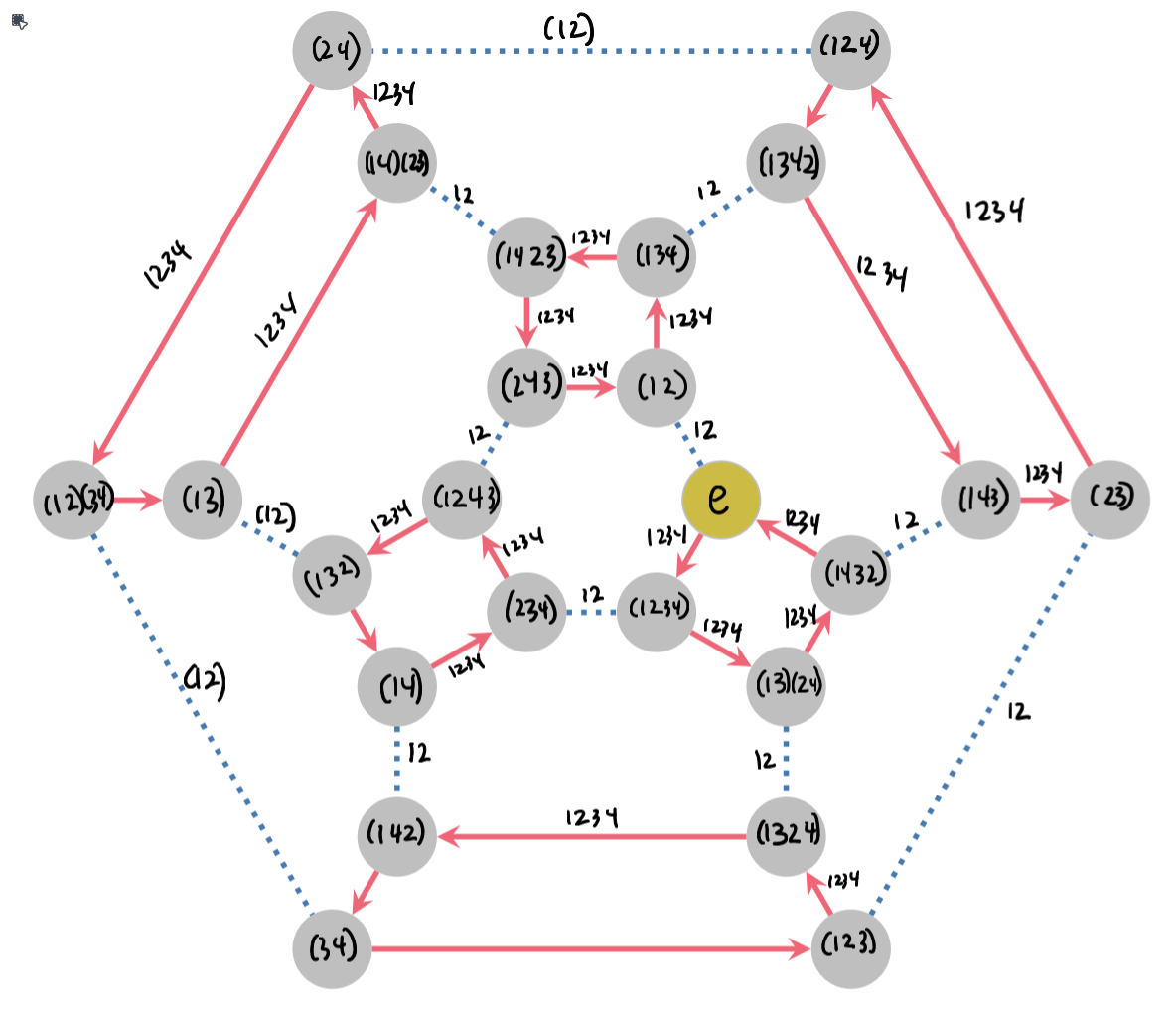
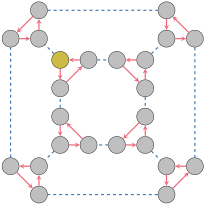
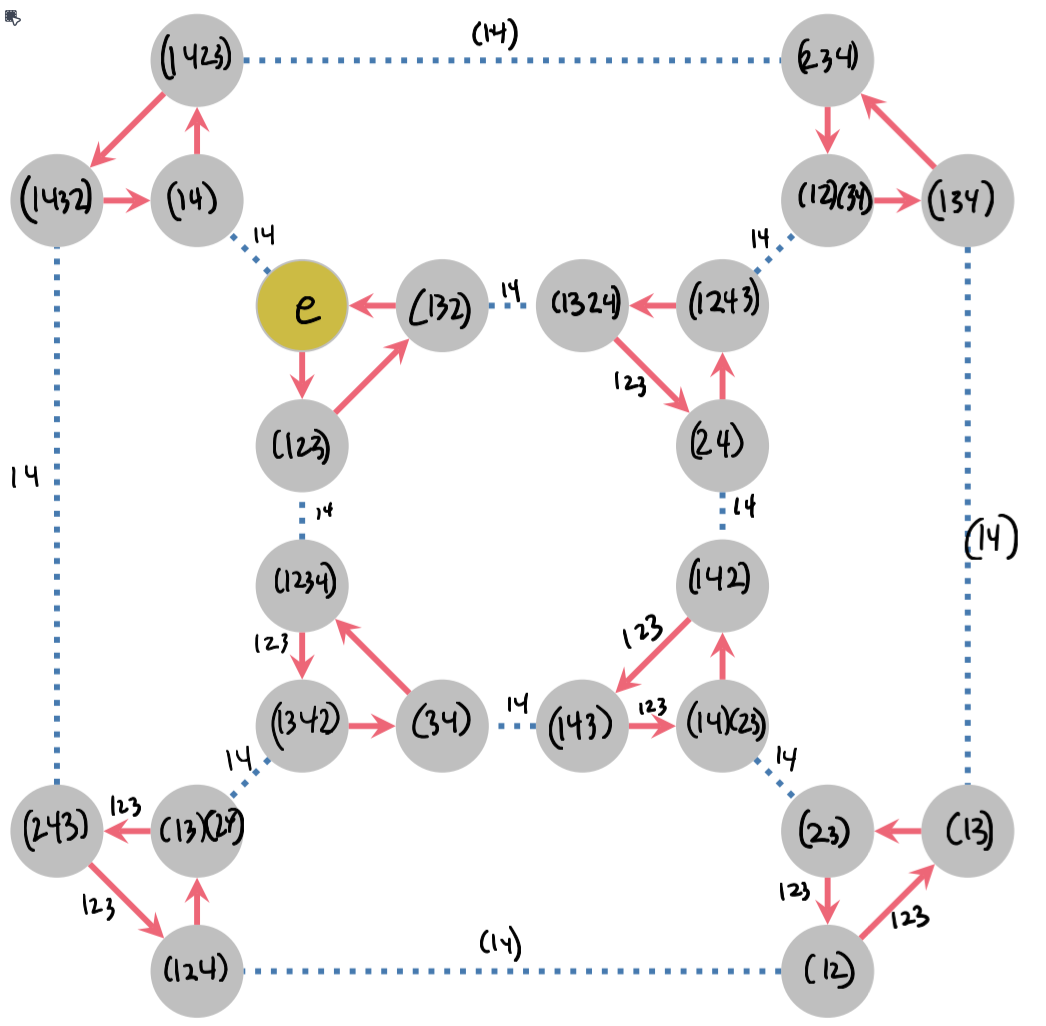
Here is a Cayley diagram for the symmetric group \(S_4\) arranged on a flattened Archimedean solid - the truncated cube. Determine what generating sets will yield this Cayley diagram. Then, label the nodes with permutations in cycle notation, written as a product of disjoint cycles.
We can see that the red arrow represents an element of order 3, which must be a 3-cycle. The blue arrow must be an element of order 2, which is either a transposition or a product of disjoint transpositions. But if the element of order 2 is a product of disjoint transpositions then every product of the generators will be an even permutation, so this cannot be a generating set. So the generators must be a 3-cycle and a transposition, and any combination of these two types of elements that involve all four numbers from 1 to 4 will work.
Problem Specs/Notes: This problem needs at least one correctly identified generating set and a correspondingly labeled copy of the Cayley diagram with at most two incorrect labels for a Success.