Skip to main content
Contents
Search Book
Search Results:
No results.
Embed Readability settings Prev Up Next \(\require{mathtools}\require{color} \setcounter{MaxMatrixCols}{15}
\newcommand{\mbu}[1]{\mathbf{\mathrm{#1}}}
\newcommand{\N}{\mathbb{N}}
\newcommand{\Z}{\mathbb{Z}}
\newcommand{\Q}{\mathbb{Q}}
\newcommand{\R}{\mathbb{R}}
\newcommand{\C}{\mathbb{C}}
\newcommand{\cC}{\mathcal{C}}
\newcommand{\F}{\mathbb{F}}
\newcommand{\GF}{\mathrm{GF}}
\DeclareMathOperator{\Span}{Span}
\DeclareMathOperator{\rank}{rank}
\DeclareMathOperator{\lcm}{lcm}
\DeclareMathOperator{\rk}{rk}
\DeclareMathOperator{\wt}{wt}
\DeclareMathOperator{\im}{im}
\makeatletter
\@ifundefined{char}{
\DeclareMathOperator{\char}{char}
}{}
\makeatother
\DeclareMathOperator{\GRS}{GRS}
\DeclareMathOperator{\RS}{RS}
\DeclareMathOperator{\BCH}{BCH}
\newcommand{\transpose}[1]{#1^{\top}}
\newcommand{\by}{\mathbf{y}}
\newcommand{\bc}{\mathbf{c}}
\newcommand{\bx}{\mathbf{x}}
\newcommand{\bm}{\mathbf{m}}
\newcommand{\bs}{\mathbf{s}}
\newcommand{\be}{\mathbf{e}}
\newcommand{\bu}{\mathbf{u}}
\newcommand{\bv}{\mathbf{v}}
\newcommand{\bh}{\mathbf{h}}
\newcommand{\br}{\mathbf{r}}
\newcommand{\bzero}{\mathbf{0}}
\newcommand{\balpha}{\boldsymbol{\alpha}}
\newcommand{\subgroup}[1]{\langle{#1}\rangle}
\newcommand{\ideal}[1]{\langle{#1}\rangle}
\newcommand{\isom}{\cong}
\DeclareMathOperator\Aut{Aut}
\DeclareMathOperator\Char{char}
\DeclareMathOperator\cl{cl}
\DeclareMathOperator\Conj{Conj}
\DeclareMathOperator\Inn{Inn}
\DeclareMathOperator\Gal{Gal}
\DeclareMathOperator\Out{Out}
\DeclareMathOperator\orb{orb}
\DeclareMathOperator\Orb{Orb}
\DeclareMathOperator\Perm{Perm}
\DeclareMathOperator\stab{stab}
\DeclareMathOperator\Stab{Stab}
\DeclareMathOperator\fix{fix}
\DeclareMathOperator\Fix{Fix}
\DeclareMathOperator\Syl{Syl}
\DeclareMathOperator\Sym{Sym}
\DeclareMathOperator\soc{soc}
\DeclareMathOperator{\nil}{nil}
\DeclareMathOperator{\Nil}{Nil}
\DeclareMathOperator\jac{jac}
\DeclareMathOperator\Jac{Jac}
\DeclareMathOperator\Eq{Eq}
\DeclareMathOperator\Hol{Hol}
\DeclareMathOperator\Frac{Frac}
\DeclareMathOperator\Ann{Ann}
\DeclareMathOperator\ev{ev}
\DeclareMathOperator\GL{GL}
\DeclareMathOperator\SL{SL}
\DeclareMathOperator\So{SO}
\DeclareMathOperator\SU{SU}
\DeclareMathOperator\PGL{PGL}
\DeclareMathOperator\PSL{PSL}
\DeclareMathOperator\PSU{PSU}
\DeclareMathOperator\PSP{PsP}
\DeclareMathOperator\AGL{AGL}
\DeclareMathOperator\Heis{Heis}
\DeclareMathOperator\Dic{Dic}
\DeclareMathOperator\SA{SA}
\DeclareMathOperator\SD{SD}
\DeclareMathOperator\Fr{Fr}
\DeclareMathOperator\Mod{Mod}
\DeclareMathOperator\DQ{DQ}
\DeclareMathOperator\QD{QD}
\DeclareMathOperator\OD{OD}
\DeclareMathOperator\Cl{Cl}
\DeclareMathOperator\BinTet{2T}
\DeclareMathOperator\BinOct{2O}
\DeclareMathOperator\BinIcos{2I}
\DeclareMathOperator\Aff{Aff}
\DeclareMathOperator\BS{BS}
\newcommand{\normal}{\lhd}
\newcommand{\normaleq}{\unlhd}
\newcommand{\nnormal}{\ntriangleleft}
\newcommand{\nnormaleq}{\ntrianglelefteq}
\def\longto{\longrightarrow}
\def\into{\hookrightarrow}
\def\longinto{\longhookrightarrow}
\def\onto{\twoheadrightarrow}
\DeclareRobustCommand\longonto{\relbar\joinrel\twoheadrightarrow}
\DeclareMathOperator{\Image}{Im}
\DeclareMathOperator\Ker{Ker}
\DeclareMathOperator{\Id}{Id}
\newcommand{\ceil}[1] {\left\lceil #1 \right\rceil}
\newcommand{\floor}[1] {\left\lfloor #1 \right\rfloor}
\definecolor{xRed}{RGB}{229, 31, 58}
\definecolor{xBlue}{RGB}{68, 119, 170}
\definecolor{xGreen}{RGB}{33, 135, 51}
\definecolor{xPurple}{RGB}{170, 51, 119}
\definecolor{xOrange}{RGB}{ 197, 83, 17}
\newcommand{\lt}{<}
\newcommand{\gt}{>}
\newcommand{\amp}{&}
\newcommand{\fillinmath}[1]{\mathchoice{\underline{\displaystyle \phantom{\ \,#1\ \,}}}{\underline{\textstyle \phantom{\ \,#1\ \,}}}{\underline{\scriptstyle \phantom{\ \,#1\ \,}}}{\underline{\scriptscriptstyle\phantom{\ \,#1\ \,}}}}
\)
Section Introduction to the Course
Worksheet Part 1: Symmetries of an Equilateral Triangle
First, you will investigate symmetries of a shape with more symmetries than a rectangle: an equilateral triangle.
Below is a diagram illustrating some symmetries of an equilateral triangle. Two symmetries are highlighted: a rotation
\(r\) by 120 degrees counterclockwise, and a reflection
\(f\) across the vertical axis through the vertex marked 1. The other axes of reflection are also shown.
Symmetry diagram for an equilateral triangle with two generators
\(r\) and
\(f\) distinguished.
\(r\) is a counterclockwise rotation by 120 degrees and
\(f\) is a reflection across a vertical axis through the vertex marked 1.
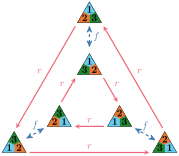
1. There are six total symmetries of this figure, including the “identity” symmetry. Draw the triangles (labeled or colored) that result from applying the six symmetries to the triangle shown above.
Solution .
This is the solution to the first two exercises.
2. Fill in edges between your triangles corresponding to the
generators \(r\) and
\(f\text{.}\) For example, if applying
\(r\) to the original triangle gives you a new triangle, draw an edge from the original triangle to that new triangle and label it
\(r\text{.}\) This produces the
Cayley diagram for the symmetries of the triangle with respect to the generators
\(r\) and
\(f\text{.}\)
3. Based on your diagram, can you identify two combinations each of the generators
\(r\) and
\(f\) which result in the reflection
\(s\) across the axis through the vertex marked 2 and the reflection
\(t\) across the axis through the vertex marked 3?
Hint .
Remember we write combinations of symmetries from right to left, so for example
\(rf\) means apply
\(f\) first and then apply
\(r\text{.}\)
Solution .
We can see that both
\(fr\) and
\(r^2f\) give the reflection
\(s\text{,}\) and both
\(rf\) and
\(fr^2\) give the reflection
\(t\text{.}\)
4.
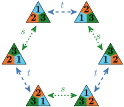
If time: Make a new copy of the 6 triangles and now draw edges corresponding to the two reflections
\(s\) and
\(t\) across the other two axes of symmetry.
Solution .
Here we arrange the six triangles into a hexagon to visualize the symmetries.