The element \((1,1)\) has order 6, so it generates \(\Z_2\times \Z_3\text{.}\) Then the map sending \(k\cdot(1,1)\) to \(k\in \Z_6\) is an isomorphism by Cyclic Groups are Isomorphic to \(\Z\) or \(\Z_n\).
Theorem84.Order of an Element in a Direct Product.
The order of an element in a direct product of a finite number of finite groups is the least common multiple of the orders of the components of the element.
Since \(|(a,b)|=\lcm(|a|,|b|)\) needs to be 6 while \(|a|\mid 36\) and \(|b|\mid 9\text{,}\) we have the following cases:
\(|a|=6\) and \(|b|=1\text{.}\) There are 2 elements of order 6 in \(\Z_{36}\) and 1 element of order 1 in \(\Z_9\text{,}\) so there are 2 elements of order 6 in this case: \((6,0)\) and \((30,0)\text{.}\)
\(|a|=6\) and \(|b|=3\text{.}\) There are 2 elements of order 3 in \(\Z_9\text{,}\) so there are 4 elements of order 6 in this case: \((6,3)\text{,}\)\((6,6)\text{,}\)\((30,3)\text{,}\) and \((30,6)\text{.}\)
\(|a|=2\) and \(|b|=3\text{.}\) There is a single element of order 2 in \(\Z_{36}\text{,}\) and still 2 elements of order 3 in \(\Z_9\text{,}\) so there are 2 elements of order 6 in this case: \((18,3)\) and \((18,6)\text{.}\)
Since there are 8 elements of order 6 in \(G\) and these come in pairs that generate the same cyclic subgroup, there are 4 cyclic subgroups of order 6 in \(G\text{.}\)
\(G\) is not cyclic, because it has more than one cyclic subgroup of order 6, but cyclic groups have a unique cyclic subgroup of each order dividing the order of the group by Fundamental Theorem of Cyclic Groups.
Suppose \(k\mid n\) and define \(U_k(n)=\{x \in U(n) \mid x\pmod{k} =1 \}\text{.}\) For the purposes of examples, you will work in \(U(42)=\{1,5,11,13,17,19,23,25,29,31,37,41 \}\)
Remark85.Isomorphism Class of the Group of Units mod a Prime Power.
It is true that \(U(2)\cong \{0\}\text{,}\)\(U(4)\cong \Z_2\text{,}\)\(U(2^n)\cong \Z_2 \times \Z_{2^{n-2}}\text{,}\) and \(U(p^n)\cong \Z_{p^{n-1}(p-1)}\) for odd primes \(p\text{.}\)
Lagrange’s theorem says the the order of any non-identity element in a group of order \(p\) is \(p\text{.}\) What does this say about groups of order 2, 3, 5, and 7?
These groups must be cyclic, generated by any non-identity element, and isomorphic to \(\Z_2\text{,}\)\(\Z_3\text{,}\)\(\Z_5\text{,}\) and \(\Z_7\text{,}\) respectively.
Lagrange’s theorem says the the order of any non-identity element in a group of order 4 is 2 or 4. Show that either \(G=\subgroup{a}\) or \(G=\{e,a,b,ab\}\isom K_4\text{.}\)
If there is an element of order 4, then the group is cyclic and generated by that element. Otherwise, all non-identity elements \(a,b,c\) have order 2 so by cancellation and the Socks-Shoes property we have that the three non-identity elements commute and satisfy \(ab=c\text{,}\) so the group is isomorphic to the Klein 4-group \(K_4\text{.}\)
We are now left with the groups of order 8. By Lagrange’s theorem, the order of any non-identity element is 2, 4, or 8. It is easiest to deal with the extreme cases first.
Now suppose that all non-identity elements have order 2. Use the fact that such a group is Abelian to help you show that the group is isomorphic to \(\Z_2 \times \Z_2 \times \Z_2\text{.}\) It will be useful to choose three distinct elements \(a,b,c\) such that \(c\neq ab\text{.}\)
Since all non-identity elements have order 2, the group is Abelian and we can find three distinct elements \(a,b,c\) such that \(c\neq ab\text{.}\) Then we claim that
By assumption, \(e,a,b,c,ab\) are all distinct. Now we have \(G=H\cup Hc\) with \(H=\{e,a,b,ab\}\) so the claim holds. Then the map \(f:\Z_2\times\Z_2\times\Z_2 \to G\) defined by \(f((i,j,k))=a^ib^jc^k\) is an isomorphism.
Now we are left with the case where there is an element of order 4, but no element of order 8. There will be three possibilities for the isomorphism class of the group, depending on how many elements of order 4 there are and how they commute. In all of these cases, let \(a\in G\) have order 4, and let \(b \in G\) be an element in \(G\setminus \subgroup{a}\text{.}\) Then we have \(G=\subgroup{A}\cup \subgroup{A}b=\{e,a,a^2,a^3,b,ab,a^2b,a^3b\}\text{.}\)
Suppose \(ba=b\text{;}\) then \(a=e\) by cancellation, a contradiction. Now suppose \(ba =a^k\) for some \(k\in \{1,2,3\}\text{.}\) Then \(b=a^{k-1}\in \subgroup{a}\) by cancellation, a contradiction.
Next, suppose that we can find \(b\) with order 2. Show that either \(ba=ab\) or \(ba=a^3b\) by showing that if \(ba=a^2b\) then \(a=ea=b^2a\) is the identity.
In this case we have elements \(a\) of order \(4\) and \(b\) of order \(2\) that commute, so the map \(f:\Z_4\times \Z_2 \to G\) defined by \(f((i,j))=a^ib^j\) is an isomorphism.
In this case we have elements \(a\) of order \(4\) and \(b\) of order \(2\) that satisfy the relation \(ba=a^3b\text{,}\) so the map \(f:D_4 \to G\) defined by \(f(r^if^j)=a^ib^j\) is an isomorphism.
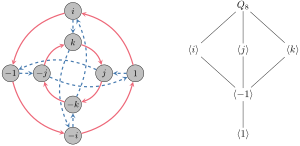
For the last case, we will need to know about a new group of order 8, the quaternion group \(Q_8=\{1,-1,i,-i,j,-j,k,-k\}\text{,}\) where \(i^2=j^2=k^2=-1\text{,}\) and \(ij=k\text{,}\)\(jk=i\text{,}\) and \(ki=j\text{.}\) This group is non-Abelian, and can represent 3D rotations, or the cross-product of vectors in 3D space, and can be used to extend the complex numbers to the quaternions. This group is generated by \(i\) and \(j\text{,}\) and has the presentation
Show that if \(b\) must be chosen to have order 4 (i.e. all elements in \(G\setminus \subgroup{a}\) have order 4), then \(b^2=a^2\text{,}\)\(ba\neq ab\) (by computing \((a^3b)^2\)), and \(ba\neq a^2b\) (by showing this implies \(a=b^2\) and deriving a contradiction). Conclude that \(G\isom Q_8\) by using the description above.
so \(a=b^2\text{.}\) But \(a\) has order \(4\) while \(b^2\) has order \(2\text{,}\) so this is also a contradiction. So we have \(ba\neq ab\) and \(ba\neq a^2b\text{.}\) Therefore the elements \(a\) and \(b\) satisfy all of the relations described in the presentation of \(Q_8\) above, so the map \(f:Q_8\to G\) defined by \(f(i^mj^n)=a^mb^n\) is an isomorphism.