Skip to main content
Contents
Search Book
Search Results:
No results.
Embed Readability settings Prev Up Next \(\require{mathtools}\require{color} \setcounter{MaxMatrixCols}{15}
\newcommand{\mbu}[1]{\mathbf{\mathrm{#1}}}
\newcommand{\N}{\mathbb{N}}
\newcommand{\Z}{\mathbb{Z}}
\newcommand{\Q}{\mathbb{Q}}
\newcommand{\R}{\mathbb{R}}
\newcommand{\C}{\mathbb{C}}
\newcommand{\cC}{\mathcal{C}}
\newcommand{\F}{\mathbb{F}}
\newcommand{\GF}{\mathrm{GF}}
\DeclareMathOperator{\Span}{Span}
\DeclareMathOperator{\rank}{rank}
\DeclareMathOperator{\lcm}{lcm}
\DeclareMathOperator{\rk}{rk}
\DeclareMathOperator{\wt}{wt}
\DeclareMathOperator{\im}{im}
\makeatletter
\@ifundefined{char}{
\DeclareMathOperator{\char}{char}
}{}
\makeatother
\DeclareMathOperator{\GRS}{GRS}
\DeclareMathOperator{\RS}{RS}
\DeclareMathOperator{\BCH}{BCH}
\newcommand{\transpose}[1]{#1^{\top}}
\newcommand{\by}{\mathbf{y}}
\newcommand{\bc}{\mathbf{c}}
\newcommand{\bx}{\mathbf{x}}
\newcommand{\bm}{\mathbf{m}}
\newcommand{\bs}{\mathbf{s}}
\newcommand{\be}{\mathbf{e}}
\newcommand{\bu}{\mathbf{u}}
\newcommand{\bv}{\mathbf{v}}
\newcommand{\bh}{\mathbf{h}}
\newcommand{\br}{\mathbf{r}}
\newcommand{\bzero}{\mathbf{0}}
\newcommand{\balpha}{\boldsymbol{\alpha}}
\newcommand{\subgroup}[1]{\langle{#1}\rangle}
\newcommand{\ideal}[1]{\langle{#1}\rangle}
\newcommand{\isom}{\cong}
\DeclareMathOperator\Aut{Aut}
\DeclareMathOperator\Char{char}
\DeclareMathOperator\cl{cl}
\DeclareMathOperator\Conj{Conj}
\DeclareMathOperator\Inn{Inn}
\DeclareMathOperator\Gal{Gal}
\DeclareMathOperator\Out{Out}
\DeclareMathOperator\orb{orb}
\DeclareMathOperator\Orb{Orb}
\DeclareMathOperator\Perm{Perm}
\DeclareMathOperator\stab{stab}
\DeclareMathOperator\Stab{Stab}
\DeclareMathOperator\fix{fix}
\DeclareMathOperator\Fix{Fix}
\DeclareMathOperator\Syl{Syl}
\DeclareMathOperator\Sym{Sym}
\DeclareMathOperator\soc{soc}
\DeclareMathOperator{\nil}{nil}
\DeclareMathOperator{\Nil}{Nil}
\DeclareMathOperator\jac{jac}
\DeclareMathOperator\Jac{Jac}
\DeclareMathOperator\Eq{Eq}
\DeclareMathOperator\Hol{Hol}
\DeclareMathOperator\Frac{Frac}
\DeclareMathOperator\Ann{Ann}
\DeclareMathOperator\ev{ev}
\DeclareMathOperator\GL{GL}
\DeclareMathOperator\SL{SL}
\DeclareMathOperator\So{SO}
\DeclareMathOperator\SU{SU}
\DeclareMathOperator\PGL{PGL}
\DeclareMathOperator\PSL{PSL}
\DeclareMathOperator\PSU{PSU}
\DeclareMathOperator\PSP{PsP}
\DeclareMathOperator\AGL{AGL}
\DeclareMathOperator\Heis{Heis}
\DeclareMathOperator\Dic{Dic}
\DeclareMathOperator\SA{SA}
\DeclareMathOperator\SD{SD}
\DeclareMathOperator\Fr{Fr}
\DeclareMathOperator\Mod{Mod}
\DeclareMathOperator\DQ{DQ}
\DeclareMathOperator\QD{QD}
\DeclareMathOperator\OD{OD}
\DeclareMathOperator\Cl{Cl}
\DeclareMathOperator\BinTet{2T}
\DeclareMathOperator\BinOct{2O}
\DeclareMathOperator\BinIcos{2I}
\DeclareMathOperator\Aff{Aff}
\DeclareMathOperator\BS{BS}
\newcommand{\normal}{\lhd}
\newcommand{\normaleq}{\unlhd}
\newcommand{\nnormal}{\ntriangleleft}
\newcommand{\nnormaleq}{\ntrianglelefteq}
\def\longto{\longrightarrow}
\def\into{\hookrightarrow}
\def\longinto{\longhookrightarrow}
\def\onto{\twoheadrightarrow}
\DeclareRobustCommand\longonto{\relbar\joinrel\twoheadrightarrow}
\DeclareMathOperator{\Image}{Im}
\DeclareMathOperator\Ker{Ker}
\DeclareMathOperator{\Id}{Id}
\newcommand{\ceil}[1] {\left\lceil #1 \right\rceil}
\newcommand{\floor}[1] {\left\lfloor #1 \right\rfloor}
\definecolor{xRed}{RGB}{229, 31, 58}
\definecolor{xBlue}{RGB}{68, 119, 170}
\definecolor{xGreen}{RGB}{33, 135, 51}
\definecolor{xPurple}{RGB}{170, 51, 119}
\definecolor{xOrange}{RGB}{ 197, 83, 17}
\newcommand{\lt}{<}
\newcommand{\gt}{>}
\newcommand{\amp}{&}
\newcommand{\fillinmath}[1]{\mathchoice{\underline{\displaystyle \phantom{\ \,#1\ \,}}}{\underline{\textstyle \phantom{\ \,#1\ \,}}}{\underline{\scriptstyle \phantom{\ \,#1\ \,}}}{\underline{\scriptscriptstyle\phantom{\ \,#1\ \,}}}}
\)
Section Day 8
This is an outline of the topics we covered in the eighth day of class. The skeleton notes are in a handout, which can be printed out using the printer icon at the top right of its section of the page for filling in during class. Filled notes for each day will be posted after class to Canvas.
Handout Thursday 6/11
Objectives: Advanced Learning Outcomes
During our class meeting, we will work on learning the following. Fluency with these is not expected or required before class.
Determine whether a given subgroup of a group is normal
State the definition/theorem: Quotient Groups
Perform computations in the quotient group
\(G/H\) for a normal subgroup
\(H\) in
\(G\)
See how the Cayley diagram of a quotient group relates to the Cayley diagram of the original group
Algebraist of the Day.
Jean-Pierre Serre , 1926-present
French mathematician, working in algebraic topology, commutative algebra, algebraic geometry
Youngest ever Fields medalist (27); first winner of the Abel prize
Example 89 . Semidirect Products Continued.
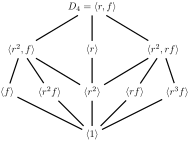
Note 90 . Normality and Subgroup Lattices.
Definition 91 . Quotient Group.
Let \(G\) be a group and \(H\normaleq G\text{.}\) Then
\begin{equation*}
G/H = \{aH\mid a \in G\}=\{Ha \mid a \in G\}
\end{equation*}
is a group under the operation
\begin{equation*}
(Ha)(Hb)=H(ab)
\end{equation*}
called the quotient of \(G\) by \(H\) .
Example 92 . Quotient of \(\Z_6\) by \(\subgroup{2}\) .
Example 93 . Quotient of \(A_4\) by \(\subgroup{(12)(34),(13)(24)}\) .
Example 94 . Cannot Quotient \(D_3\) by \(\subgroup{f}\) .
Algorithm 95 .
To take the quotient of a group \(G\) by a normal subgroup \(H\text{,}\) do the following:
Draw a Cayley graph of
\(G\text{,}\) preferably so that the right cosets of
\(H\) are visible and clustered.
Collapse each right coset of
\(H\) to a single point.
Preserve edges between cosets. That is, there is a
\(g\) -edge from
\(Ha\) to
\(Hb\) if and only if there is
\(g\) -edge in the original graph from some element of
\(Ha\) to some element of
\(Hb\text{.}\)
This process suceeds if and only if the resulting graph is a valid Cayley graph.