
Worksheet Weekly Practice 1

Instructions: You may type up or handwrite your work, but it must be neat, professional, and organized and it must be saved as a PDF file and uploaded to the appropriate Gradescope assignment. Use a scanner or scanning app to convert handwritten work on paper to PDF. I encourage you to type your work using the provided template.
All tasks below must have a complete solution that represents a good-faith attempt at being right to receive engagement credits. If your submission is complete and turned in on time, you will receive full engagement credit for the assignment. All other submissions will receive zero engagement credit. Read the guidelines at Grading Specifications carefully.
To abide by the class academic honesty policy, your work should represent your own understanding in your own words. If you work with other students, you must clearly indicate who you worked with in your submission. The same is true for using tools like generative AI although I strongly discourage you from using such tools since you need to build your own understanding here to do well on exams.

True/False, Multiple Choice, & Fill-In.

For these problems a justification is not required for credit, but it may be useful for your own understanding to include one. True/False problems should be marked True if the statement is always true, and False otherwise. Multiple choice problems may have more than one correct answer if that is indicated in the problem statement; be sure to select all that apply. Fill-in problems require a short answer such as a number, word, or phrase.

1.

Fill-In: A group is a set with a binary operation that has three properties. Fill them in below, using precise mathematical language.
Solution.
A group is a set with a binary operation that is associative (\((ab)c=a(bc)\) for all \(a,b,c\in G\)), has an identity element \(e\) such that \(ae=ea=a\) for all \(a\in G\text{,}\) and has inverses for every element so that for each \(a\in G\) there is an element \(b\in G\) such that \(ab=ba=e\text{.}\)

2.

True/False: The Cayley graph of a group has one arrow at each node.
Solution.
False. The Cayley graph has one arrow for each chosen generator at each node.

3.

True/False: All groups are Abelian.
Solution.
False. Many groups (in fact most groups) are not Abelian. For example, \(D_3\) and Hex and \(\GL_n(\R)\text{.}\)

Short Response.

Your responses to these questions should be complete solutions with justifications, as per the Grading Specifications.

4. Symmetries of a Hexagon.

The twelve symmetries of a hexagon form a group, that for now, we will call Hex. Let \(r\) be a 60Β° counterclockwise rotation and \(f\) a horizontal flip.

(a)

Construct a Cayley graph for \(\mathrm{\mathbf{Hex}}=\langle r,f\rangle\text{.}\)
Solution.
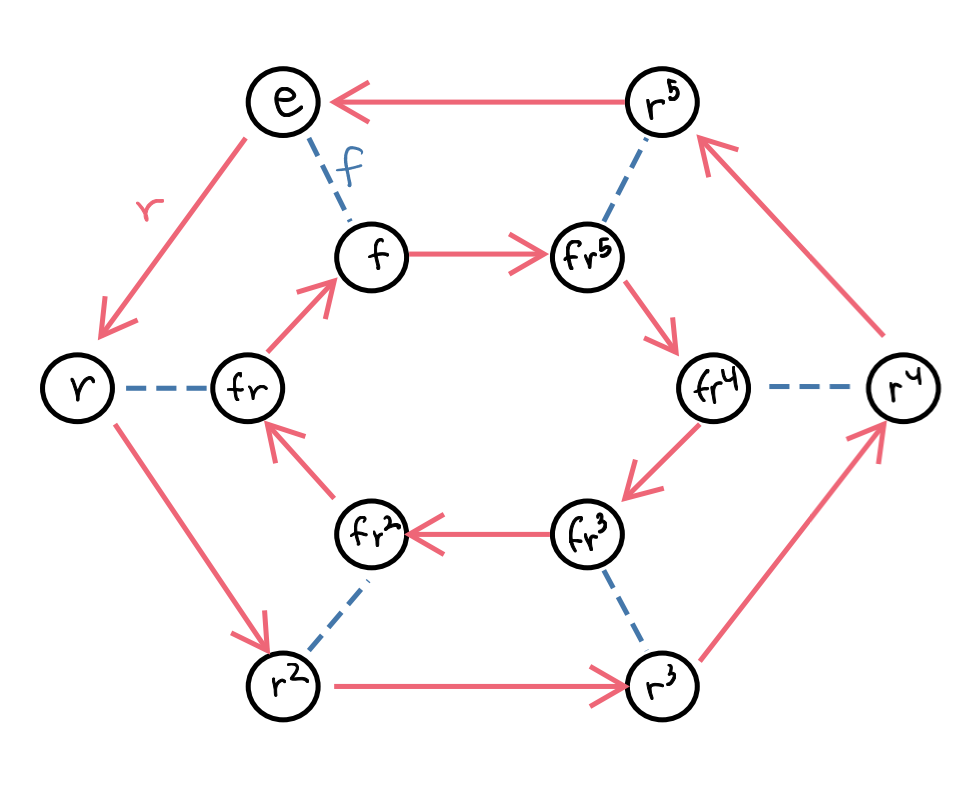
One possible rendering of this Cayley graph, with nodes labeled by group elements rather than states of the hexagon, is shown below.
Cayley graph for D_6 with generating set r,f
The Cayley graph for \(D_6\) with generators \(r,f\) consists of two hexagons. One consists of the six rotations and has an edge labeled with \(r\) oriented counterclockwise between each pair of nodes. The other consists of the six reflections and has an edge labeled with \(r\) oriented clockwise between each pair of nodes. An undirected edge labeled \(f\) connects each rotation \(r^i\) to the reflection \(fr^i\text{.}\)

(b)

Find all of the minimal generating sets consisting of a reflection and rotation.
Solution.
First, all two element generating sets are minimal, because this group is not cyclic (as it has no element of order 12). Second, combining either of the two rotations that generate the subgroup \(\subgroup{r}\text{,}\) namely \(r\) and \(r^5\text{,}\) with any reflection generates the whole group. The six reflections in this group are shown in the Cayley graph above in the form \(fr^i\) for \(0\leq i \leq 5\text{.}\) We saw in class with \(D_4\) as the symmetries of the square that we have the identity \(rf=fr^{-1}\) and this holds here as well. It follows (by repeatedly applying this) that \(r^i f = f r^{-i}\text{.}\)
Now, can we generate all of Hex with \(r^2,r^3\text{,}\) or \(r^4\) and a reflection? To do so, we must be able to get \(r\text{.}\) But this is impossible. From \(r^2\) or \(r^4\) and any reflection \(s=fr^i=r^{6-i}f\) we claim can only get the following elements, since \(s^2=1\text{:}\)
\begin{equation*} e, r^2, r^4, s, r^2 s, r^4s\text{.} \end{equation*}
Further multiplying on the right by copies of \(s\) does nothing, and we have the rule
\begin{equation*} sr=fr^{i+1}=r^{5-i}f=r^{-1}s \end{equation*}
so we can see that we cannot achieve any odd power of \(r\) by trying to multiply on the left as well. A similar argument holds for \(r^3\) and any reflection. So the possible generating sets are
\begin{align*} \amp \{r,f\}, \{r,fr\}, \{r,fr^2\},\{r,fr^3\},\{r,fr^4\},\{r,fr^5\} \\ \amp \{r^5,f\}, \{r^5,fr\}, \{r^5,fr^2\},\{r^5,fr^3\},\{r^5,fr^4\},\{r^5,fr^5\} \end{align*}

(c)

Find all minimal generating sets consisting of two reflections.
Solution.
Again, any such generating set is necessarily minimal, and again we need to be able to get \(r\) from the two chosen reflections. So we attempt to solve
\begin{equation*} (r^if)(r^jf)=r \end{equation*}
for pairs \(i,j\text{.}\) We have
\begin{equation*} (r^if)(r^jf)=r^i(fr^j)f=r^{i-j}f\text{.} \end{equation*}
This is true exactly when \(i-j\equiv 1 \pmod 6\text{.}\) So the possible two reflection generating sets are
\begin{equation*} \{rf,f\}, \{r^2f,rf\}, \{r^3f,r^2f\}, \{r^4f, r^3f\}, \{r^5f,r^4f\}, \{r^5f,f\}\text{.} \end{equation*}

(d)

Find all minimal generating sets that have three symmetries.
Solution.
First any such set must contain at least one reflection, since any set of rotations generates at most the subgroup of rotations. It must not contain as a subset any two element generating set, all of which are listed in the previous two parts. So it cannot contain either \(r\) or \(r^5\) and it cannot contain any pair of reflections over adjacent axes (i.e. any of the pairs of reflections that generate the whole group).
First, let’s find the minimal generating sets containing two rotations and one reflection, if such exist. By the argument we outlined in (b), we cannot generate \(r\) from any one reflection and only \(r^2\) and \(r^4\text{,}\) but \(\{r^2,r^3,s\}\) and \(\{r^4,r^3,s\}\) for any reflection \(s\) both work, since \((r^3)(r^2)^2=r=(r^3)(r^4).\) So there are twelve minimal generating sets containing two rotations and one reflection.
\begin{align*} \amp \{r^2, r^3, f\}, \{r^2, r^3, fr\}, \{r^2, r^3, fr^2\} \\ \amp \{r^2, r^3, fr^3\}, \{r^2, r^3, fr^4\}, \{r^2, r^3, fr^5\} \\ \amp \{r^4, r^3, f\}, \{r^4, r^3, fr\}, \{r^4, r^3, fr^2\} \\ \amp \{r^4, r^3, fr^3\}, \{r^4, r^3, fr^4\}, \{r^4, r^3, fr^5\} \text{.} \end{align*}
Now, consider minimal generating sets containing one rotation and two reflections. Since we can get \(r\) if we have both \(r^3\) and either \(r^2\) or \(r^4\text{,}\) we need one of these three rotations and a pair of reflections that generate one from the other set. By the argument of the last part this gives the following sets:
\begin{align*} \amp \{r^3, f, fr^2\}, \{r^3, fr^2, fr^4\}, \{r^3, fr^4, f\} \\ \amp \{r^3, fr, fr^3\}, \{r^3, fr^3, fr^5\}, \{r^3, fr^5, fr\} \\ \amp \{r^2, f, fr^3\}, \{r^2, fr, fr^4\}, \{r^2, fr^2, fr^5\} \\ \amp \{r^4, f, fr^3\}, \{r^4, fr, fr^4\}, \{r^4, fr^2, fr^5\} \text{.} \end{align*}
Finally, we consider if there are any minimal generating sets containing three reflections. To generate with only reflections, we must have a pair as in part (c), but this will then not be a minimal generating set. So no such generating sets exist.
Problem Specs/Notes: This problem needs justification both of the fact that your claimed sets are generating sets and that they are minimal for a Success.

5. Instances of a Group.

For each pair of a set and operation below, decide whether or not it is a group. If it is a group, give an explanation of why each part of the definition is satisfied. If it is not a group, give an example showing which part of the definition is not satisfied.

(a)

The integers \(\mathbb{Z}\) under subtraction.
Solution.
The integers do not form a group under subtraction because subtraction is not generally associative. For example,
\begin{equation*} 1-(1-1)=1, \end{equation*}
but
\begin{equation*} (1-1)-1=-1. \end{equation*}

(b)

The set of invertible \(2\times 2\) matrices over \(\R\text{,}\) \(\GL(2,\mathbb{R})\text{,}\) under matrix multiplication.
Solution.
This set is a group. It is closed under matrix multiplication because a matrix over \(\R\) is invertible if and only if its determinant is non-zero and we have \(\det(AB)=\det(A)\det(B)\text{.}\) So if \(A,B \in \GL(2,\mathbb{R})\text{,}\) then \(\det(A)\det(B)\neq 0\) since \(\det(A),\det(B)\neq 0\) and thus \(AB\in\GL(2,\mathbb{R})\text{.}\)
Further, matrix multiplication is associative. The matrix \(I_{2}=\begin{bmatrix}1 & 0 \\ 0 & 1\end{bmatrix}\) is invertible (it is its own inverse), so the group has an identity.
Finally, the inverse of any \(2\times 2\) matrix \(A=\begin{bmatrix}a & b \\ c & d\end{bmatrix}\) is
\begin{equation*} A^{-1}=\dfrac{1}{ad-bc}\begin{bmatrix}d & -b \\ -c & a\end{bmatrix}. \end{equation*}
This matrix has \(\det(A^{-1})=\frac{1}{\det(A)}\) hence is in \(\GL(2,\mathbb{R}).\)
Problem Specs/Notes: This problem needs a counterexample to one of the group axioms if you are showing a set/operation pair is not a group and a clear articulation of why all group axioms are satisfied if you are showing a set/operation pair is a group for a Success.

6. Computation Mod 8.

For this problem you will work in the group \(\Z_{8}\) with the operation of addition mod 8.

(a)

List the elements of the set \(S=\{x\in\Z_{8}\mid x+x =e\}\text{.}\)
Solution.
These are the elements in \(\{0,1,2,3,4,5,6,7\}\) which when added to themselves are 0 mod 8, so
\begin{equation*} S =\{0,4\}. \end{equation*}

(b)

List the elements of the set \(\langle 2\rangle\text{.}\)
Solution.
These are the elements \(\{2,4,6,0\}\text{.}\) After these the elements repeat for other positive or negative sums of \(2\text{.}\)

7. Checking for Subgroups.

Use one of the subgroup tests to show that the set \(\SL(2,\R)\) of all \(2\times 2\) matrices over \(\R\) with determinant 1 is a subgroup of \(\GL(2,\R)\text{.}\)
Solution.
We use the one-step subgroup test. First, \(\SL(2,\R)\) is non-empty because \(I_{2}\) has determinant 1 and thus is an element of \(\SL(2,\R)\text{.}\) Second, suppose \(A,B \in \SL(2,\R)\text{.}\) Then \(\det(A)=1\) and \(\det(B)=1\text{,}\) so \(\det(B^{-1})=1/\det(B)=1\text{.}\) Therefore \(\det(AB^{-1})=\det(A)\det(B^{-1})=(1)(1)=1\text{,}\) so \(AB^{-1}\in\SL(2,\R)\) as well. Therefore \(\SL(2,\R)\) is a subgroup of \(\GL(2,\R)\) by the one-step subgroup test.

