Worksheet Weekly Practice 3

Instructions: You may type up or handwrite your work, but it must be neat, professional, and organized and it must be saved as a PDF file and uploaded to the appropriate Gradescope assignment. Use a scanner or scanning app to convert handwritten work on paper to PDF. I encourage you to type your work using the provided template.
All tasks below must have a complete solution that represents a good-faith attempt at being right to receive engagement credits. If your submission is complete and turned in on time, you will receive full engagement credit for the assignment. All other submissions will receive zero engagement credit. Read the guidelines at Grading Specifications carefully.
To abide by the class academic honesty policy, your work should represent your own understanding in your own words. If you work with other students, you must clearly indicate who you worked with in your submission. The same is true for using tools like generative AI although I strongly discourage you from using such tools since you need to build your own understanding here to do well on exams.

True/False, Multiple Choice, & Fill-In.

For these problems a justification is not required for credit, but it may be useful for your own understanding to include one. True/False problems should be marked True if the statement is always true, and False otherwise. Multiple choice problems may have more than one correct answer if that is indicated in the problem statement; be sure to select all that apply. Fill-in problems require a short answer such as a number, word, or phrase.

2.

Definition/Theorem: State Lagrange’s Theorem for finite groups.
Solution.
Lagrange’s Theorem states that if \(G\) is a finite group and \(H\) is a subgroup of \(G\text{,}\) then the order of \(H\) divides the order of \(G\text{.}\)

3.

True/False: The left and right cosets of a subgroup \(H\) in \(G\) are always the same sets.
Solution.
False. For instance, the left and right cosets of \(\subgroup{f}\) in \(D_4\) are different.

Short Response.

Your responses to these questions should be complete solutions with justifications, as per the Grading Specifications.

4.

Give an example of a cyclic group of smallest possible order that contains a subgroup isomorphic to \(\Z_{12}\) and a subgroup isomorphic to \(\Z_{20}\text{.}\) Explain your reasoning.
Solution.
The required subgroups are cyclic subgroups of order 12 and 20, so by the Fundamental Theorem of Cyclic Groups, the order of the group must be a multiple of 12 and 20. So the smallest possible order is \(\lcm(12,20)=60\) and a group with this structure is \(\Z_{60}\text{.}\)
Problem Specs/Notes: This problem needs a correct identification of the smallest possible order and a complete justification (with reference to a theorem) for a Success.

5.

In this question, you will work out the structure of \(\Aut(\Z_{8})\text{.}\)

(a)

Suppose \(\phi \in \Aut(\Z_{8})\) satisfies \(\phi(1)=3\text{.}\) Find a formula for \(\phi(k)\) for any \(k\in\Z_{8}\text{.}\)
Solution.
Since \(\phi\) is an isomorphism, \(\phi(k)=\phi(k\cdot 1)=k\phi(1)\) for any \(k\in\Z_{8}\text{.}\) So
\begin{equation*} \phi(k)=3k\bmod 8 \end{equation*}
for any \(k\in\Z_{8}\text{.}\)

(b)

Are there any elements \(b\in \Z_{8}\) so that \(\phi(1)\) cannot be \(b\text{?}\) If so, what are they and why?
Solution.
Yes, there are. \(\Z_{8}\) is a cyclic group, so any automorphism must map \(1\) to a generator of the group (else it will not be 1-to-1 or onto) and as we saw in (a) this will totally determine the automorphism.
The elements of \(\Z_{8}\) that do not generate \(\Z_{8}\) are those not relatively prime to \(8\text{,}\) namely \(0,2,4\text{,}\) and \(6\text{.}\) We could let \(\phi(1)\) be any element from the set \(\{1,3,5,7\}\text{.}\)

(c)

Make a conjecture about what familiar group is isomorphic to \(\Aut(\Z_{8})\text{.}\)
Solution.
We saw above that an automorphism of \(\Z_{8}\) is determined by \(\phi(1)\) and that \(\phi(1)\) can be any element of \(\Z_{8}\) relatively prime to \(8\text{.}\) Further, if \(\phi_{1}(1)=b_{1}\) and \(\phi_{2}(1)=b_{2}\text{,}\) then
\begin{equation*} \phi_{2}(\phi_{1}(1))=\phi_{2}(b_{1})=b_{1}b_{2}, \end{equation*}
so composing these automorphisms results in multiplying the values chosen for \(\phi(1)\text{.}\)
Therefore we see that \(\Aut(\Z_{8}) \cong U_{8}\) by the map \(\psi:\Aut(\Z_{8})\to U_{8}\) given by
\begin{equation*} \psi(\phi)=\phi(1). \end{equation*}
Problem Specs/Notes: This problem needs correct, complete responses to the first two parts and a reasonable conjecture in part (c) (for instance the group conjectured must be the right size) for a Success.

6.

Suppose \(\phi: \Z_{50}\to\Z_{50}\) is an automorphism with \(\phi(11)=13\text{.}\) Determine a formula for \(\phi(x)\text{.}\)
Solution.
There are a variety of approaches to this problem. If we know \(\phi(1)\) it is simple to determine a formula, since we must have \(\phi(k)=k\phi(1)\) for any \(k\in \Z_{50}\text{.}\) Similarly, since \(1=11 m \bmod 50\) for some \(2\leq m \leq 49\text{,}\) we have \(\phi(1)=m\phi(11) \bmod 50 =13m\mod 50\text{.}\) So we need only determine the required value of \(m\text{.}\)
We need the ones digit of \(11m\) to be a \(1\text{,}\) which means \(m\) ends in a 1. A quick computation of \((11)(11)\text{,}\) \((11)(21)\text{,}\) \((11)(31)\text{,}\) and \((11)(41)\) shows that \(m=41\) is the needed value.
So \(\phi(1)=13\cdot 41 \mod 50 =33\text{.}\) Therefore
\begin{equation*} \phi(x)=33x \mod 50 \end{equation*}
for any \(x\in \Z_{50}\text{.}\)
Problem Specs/Notes: This problem needs a clear argument for why your claimed formula is correct for a Success.

7.

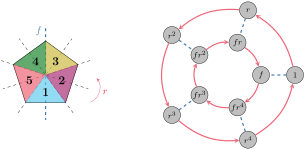
All of the subgroups of \(D_5\) can be determined quickly by thinking about symmetries of a regular pentagon, shown below at left. At right is a Cayley graph.
Regular pentagon with labeled corners and the Cayley graph of its symmetries

(a)

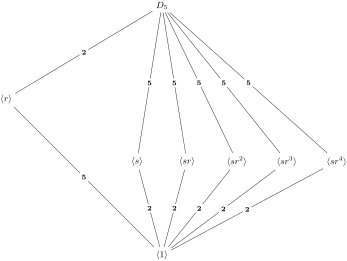
Construct a subgroup lattice for \(D_5\text{.}\) Label each edge from \(H\) to \(K\) with \([H:K]\text{.}\)
Solution.
The lattice is below.
Subgroup lattice for D_5 showing the six nontrivial subgroups and their indices

(b)

Find the left and right cosets of the subgroups \(\subgroup{r}\) and \(\subgroup{f}\text{.}\)
Solution.
The left cosets of \(\subgroup{r}\) are \(\subgroup{r}\) and \(f\subgroup{r}=\{f,fr,fr^2,fr^3,fr^4\}\text{,}\) and the right cosets of \(\subgroup{r}\) are \(\subgroup{r}\) and \(\subgroup{r}f=\{f,rf,r^2f,r^3f,r^4f\}\text{.}\)
The left cosets of \(\subgroup{f}\) are
\begin{align*} \subgroup{f} \amp = \{1,f\}, \\ r\subgroup{f}\amp =\{r,rf\},\\ r^2\subgroup{f}\amp =\{r^2,r^2f\},\\ r^3\subgroup{f}\amp =\{r^3,r^3f\},\\ r^4\subgroup{f}\amp =\{r^4,r^4f\}\text{.} \end{align*}
The right cosets of \(\subgroup{f}\) are
\begin{align*} \subgroup{f} \amp = \{1,f\}, \\ \subgroup{f}r\amp =\{r,fr\},\\ \subgroup{f}r^2\amp = \{r^2,fr^2\},\\ \subgroup{f}r^3\amp = \{r^3,fr^3\},\\ \subgroup{f}r^4\amp = \{r^4,fr^4\}\text{.} \end{align*}

(c)

The normalizer of \(H\leq G\text{,}\) denoted \(N_G(H)\text{,}\) is the union of the left cosets of \(H\) that are also right cosets. Find the normalizer of \(\subgroup{r}\) and \(\subgroup{f}\text{.}\)
Solution.
We can use the relation \(rf=fr^{-1}\) to work out how the cosets compare. From this we see that the normalizer of \(\subgroup{r}\) is \(D_5\) since the left and right cosets of \(\subgroup{r}\) are the same. The normalizer of \(\subgroup{f}\) is \(\subgroup{f}\) since the only left coset of \(\subgroup{f}\) that is also a right coset is \(\subgroup{f}\) itself.

(d)

Two subgroups \(H,K\leq G\) are conjugate if
\begin{equation*} K=gHg^{-1}:=\{ghg^{-1}\mid h\in H\} \end{equation*}
for some \(g\in G\text{.}\) This defines an equivalence relation on the set of subgroups called conjugacy classes. Partition the subgroups of \(D_5\) into conjugacy classes.
Solution.
First, all of the normal subgroups of \(D_5\) are in their own conjugacy class, so \(\{1\}, \subgroup{r}, D_5\) are each in their own conjugacy class. Then the size two subgroups generated by a reflection are all conjugate because we have
\begin{equation*} r^j(f)r^{-j} = fr^{-j}r^{-j}=fr^{-2j} \end{equation*}
and we can choose \(j\) to get any value of \(-2j\bmod 5\text{,}\) so all of the reflections subgroups are conjugate to \(\subgroup{f}\) and hence to each other. Explicitly,
\begin{equation*} rfr^{-1}=fr^3, r^2fr^{-2}=fr, r^3fr^{-3}=fr^4, r^4fr^{-4}=fr^2. \end{equation*}
Thus the conjugacy classes of \(D_5\) are:
\begin{gather*} \{\subgroup{1}\}, \\ \{\subgroup{r}\}, \\ \{\subgroup{f},\, \subgroup{fr},\, \subgroup{fr^2},\, \subgroup{fr^3}, \subgroup{fr^4}\}, \\ \{D_5\}. \end{gather*}
Problem Specs/Notes: This problem needs responses supported with clear reference to either previous parts or computations within the part for a Success.