Skip to main content
Contents
Search Book
Search Results:
No results.
Embed Readability settings Prev Up Next \(\require{mathtools}\require{color} \setcounter{MaxMatrixCols}{15}
\newcommand{\mbu}[1]{\mathbf{\mathrm{#1}}}
\newcommand{\N}{\mathbb{N}}
\newcommand{\Z}{\mathbb{Z}}
\newcommand{\Q}{\mathbb{Q}}
\newcommand{\R}{\mathbb{R}}
\newcommand{\C}{\mathbb{C}}
\newcommand{\cC}{\mathcal{C}}
\newcommand{\F}{\mathbb{F}}
\newcommand{\GF}{\mathrm{GF}}
\DeclareMathOperator{\Span}{Span}
\DeclareMathOperator{\rank}{rank}
\DeclareMathOperator{\lcm}{lcm}
\DeclareMathOperator{\rk}{rk}
\DeclareMathOperator{\wt}{wt}
\DeclareMathOperator{\im}{im}
\makeatletter
\@ifundefined{char}{
\DeclareMathOperator{\char}{char}
}{}
\makeatother
\DeclareMathOperator{\GRS}{GRS}
\DeclareMathOperator{\RS}{RS}
\DeclareMathOperator{\BCH}{BCH}
\newcommand{\transpose}[1]{#1^{\top}}
\newcommand{\by}{\mathbf{y}}
\newcommand{\bc}{\mathbf{c}}
\newcommand{\bx}{\mathbf{x}}
\newcommand{\bm}{\mathbf{m}}
\newcommand{\bs}{\mathbf{s}}
\newcommand{\be}{\mathbf{e}}
\newcommand{\bu}{\mathbf{u}}
\newcommand{\bv}{\mathbf{v}}
\newcommand{\bh}{\mathbf{h}}
\newcommand{\br}{\mathbf{r}}
\newcommand{\bzero}{\mathbf{0}}
\newcommand{\balpha}{\boldsymbol{\alpha}}
\newcommand{\subgroup}[1]{\langle{#1}\rangle}
\newcommand{\ideal}[1]{\langle{#1}\rangle}
\newcommand{\isom}{\cong}
\DeclareMathOperator\Aut{Aut}
\DeclareMathOperator\Char{char}
\DeclareMathOperator\cl{cl}
\DeclareMathOperator\Conj{Conj}
\DeclareMathOperator\Inn{Inn}
\DeclareMathOperator\Gal{Gal}
\DeclareMathOperator\Out{Out}
\DeclareMathOperator\orb{orb}
\DeclareMathOperator\Orb{Orb}
\DeclareMathOperator\Perm{Perm}
\DeclareMathOperator\stab{stab}
\DeclareMathOperator\Stab{Stab}
\DeclareMathOperator\fix{fix}
\DeclareMathOperator\Fix{Fix}
\DeclareMathOperator\Syl{Syl}
\DeclareMathOperator\Sym{Sym}
\DeclareMathOperator\soc{soc}
\DeclareMathOperator{\nil}{nil}
\DeclareMathOperator{\Nil}{Nil}
\DeclareMathOperator\jac{jac}
\DeclareMathOperator\Jac{Jac}
\DeclareMathOperator\Eq{Eq}
\DeclareMathOperator\Hol{Hol}
\DeclareMathOperator\Frac{Frac}
\DeclareMathOperator\Ann{Ann}
\DeclareMathOperator\ev{ev}
\DeclareMathOperator\GL{GL}
\DeclareMathOperator\SL{SL}
\DeclareMathOperator\So{SO}
\DeclareMathOperator\SU{SU}
\DeclareMathOperator\PGL{PGL}
\DeclareMathOperator\PSL{PSL}
\DeclareMathOperator\PSU{PSU}
\DeclareMathOperator\PSP{PsP}
\DeclareMathOperator\AGL{AGL}
\DeclareMathOperator\Heis{Heis}
\DeclareMathOperator\Dic{Dic}
\DeclareMathOperator\SA{SA}
\DeclareMathOperator\SD{SD}
\DeclareMathOperator\Fr{Fr}
\DeclareMathOperator\Mod{Mod}
\DeclareMathOperator\DQ{DQ}
\DeclareMathOperator\QD{QD}
\DeclareMathOperator\OD{OD}
\DeclareMathOperator\Cl{Cl}
\DeclareMathOperator\BinTet{2T}
\DeclareMathOperator\BinOct{2O}
\DeclareMathOperator\BinIcos{2I}
\DeclareMathOperator\Aff{Aff}
\DeclareMathOperator\BS{BS}
\newcommand{\normal}{\lhd}
\newcommand{\normaleq}{\unlhd}
\newcommand{\nnormal}{\ntriangleleft}
\newcommand{\nnormaleq}{\ntrianglelefteq}
\def\longto{\longrightarrow}
\def\into{\hookrightarrow}
\def\longinto{\longhookrightarrow}
\def\onto{\twoheadrightarrow}
\DeclareRobustCommand\longonto{\relbar\joinrel\twoheadrightarrow}
\DeclareMathOperator{\Image}{Im}
\DeclareMathOperator\Ker{Ker}
\DeclareMathOperator{\Id}{Id}
\newcommand{\ceil}[1] {\left\lceil #1 \right\rceil}
\newcommand{\floor}[1] {\left\lfloor #1 \right\rfloor}
\definecolor{xRed}{RGB}{229, 31, 58}
\definecolor{xBlue}{RGB}{68, 119, 170}
\definecolor{xGreen}{RGB}{33, 135, 51}
\definecolor{xPurple}{RGB}{170, 51, 119}
\definecolor{xOrange}{RGB}{ 197, 83, 17}
\newcommand{\lt}{<}
\newcommand{\gt}{>}
\newcommand{\amp}{&}
\newcommand{\fillinmath}[1]{\mathchoice{\underline{\displaystyle \phantom{\ \,#1\ \,}}}{\underline{\textstyle \phantom{\ \,#1\ \,}}}{\underline{\scriptstyle \phantom{\ \,#1\ \,}}}{\underline{\scriptscriptstyle\phantom{\ \,#1\ \,}}}}
\)
Section Day 1
This is an outline of the topics we covered in the first day of class. The skeleton notes are in a handout, which can be printed out using the printer icon at the top right of its section of the page for filling in during class. Filled notes for each day will be posted after class to Canvas.
Handout Tuesday 5/19
Objectives: Advanced Learning Outcomes
During our class meeting, we will work on learning the following. Fluency with these is not expected or required before class.
Get to know each other and the course.
Explore symmetries as an introduction to group theory.
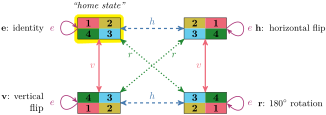
Create or complete a Cayley graph for the symmetries of a figure
Algebraist of the Day.
Evariste Galois , 1811-1832
Founded modern group theory in the context of solving polynomial equations by radicals.
Failed the entrance exam to the École Polytechnique twice; died in a duel at age 20.
Introduced normal subgroups, isomorphisms, simple groups, and Galois theory.
Definition 4 . Symmetry.
A
symmetry of an object is a transformation of that object which preserves its structure. For example, a rotation or reflection of a plane figure which results in the figure lying in the same place is a symmetry of that figure.
Example 5 .
For instance, let’s think about a rectangle.
Example 6 .
Another example of symmetry is that enjoyed by a pinwheel toy.
Definition 7 . Group.
Let \(G\) be a set together with a binary operation \(\circ\) (usually called multiplication) that assigns to each ordered pair \((a,b)\) of elements of \(G\) an element in \(G\) denoted by \(a\circ b\) or \(ab\text{.}\) We say that \((G,\circ)\) is a group if the following conditions hold:
Associativity . The operation is associative; that is,
\((ab)c=a(bc)\) for all
\(a,b,c\in G\text{.}\)
Identity . There is an element
\(e\in G\) (called the
identity ) such that
\(ae=ea=a\) for all
\(a\in G\text{.}\)
Inverses . For each element
\(a\in G\text{,}\) there is an element
\(b\in G\) (called an
inverse of
\(a\) ) such that
\(ab=ba=e\text{.}\)
Example 8 . Examples of a Group.
Some examples of a group include: