Section Inner Automorphisms

Worksheet Automorphism and Inner Automorphism Groups

The goal of these problems is to continue working with isomorphisms of groups and investigate the automorphism group and inner automorphism group of a group.

Definition 64. Inner Automorphism.

If \(G\) is a group and \(a\in G\text{,}\) the inner automorphism of \(G\) induced by \(a\) is the function \(\phi_a\) defined by
\begin{equation*} \phi_a(x)=axa^{-1}\text{.} \end{equation*}
The set of all inner automorphisms of a group \(G\) forms a subgroup of \(\Aut(G)\text{,}\) called the inner automorphism group of \(G\text{,}\) denoted \(\Inn(G)\text{.}\)

1.

You showed on the previous sheet that this is indeed an automorphism of \(G\text{.}\) Now prove that \(\Inn(G)=\{ \phi_a \mid a \in G \}\) is a group under function composition.
Solution.
These are a subset of the automorphisms of \(G\text{,}\) so we use the Two-Step Subgroup Test. Since \(G\) is nonempty, so is \(\Inn(G)\text{.}\) Let \(\phi_a, \phi_b \in \Inn(G)\text{.}\) Then we have
\begin{equation*} \phi_{a} (\phi_b(x)) = a(bxb^{-1})a^{-1} = (ab)x(ab)^{-1}=\phi_{ab}(x)\text{,} \end{equation*}
so \(\phi_a \circ \phi_b = \phi_{ab}\) is an inner automorphism. Applying the same fact with \(b=a^{-1}\) shows that \(\phi_a^{-1}=\phi_{a^{-1}}\) is an inner automorphism. Thus \(\Inn(G)\) is a subgroup of \(\Aut(G)\text{.}\)

2.

Compute the action of the inner automorphism \(\phi_{3}\) on \(\Z_8\text{.}\)
Solution.
We have
\begin{equation*} \phi_3(x)=3+x-3=x \end{equation*}
for all \(x\in \Z_8\text{,}\) so \(\phi_3\) is the identity map on \(\Z_8\text{.}\) This holds more generally: if \(G\) is an Abelian group, then \(\Inn(G)\isom\{e\}\text{.}\)

3.

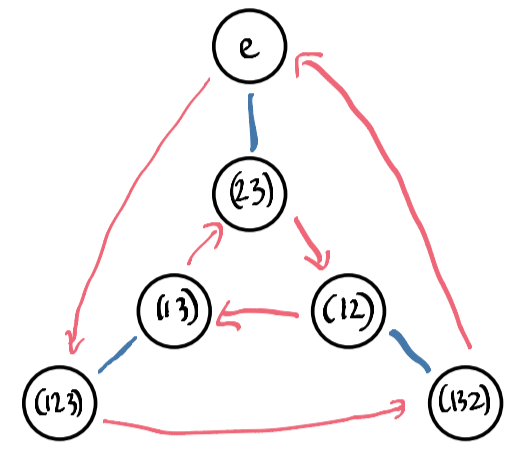
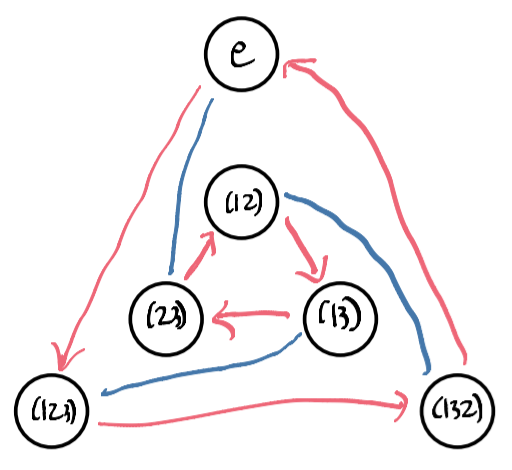
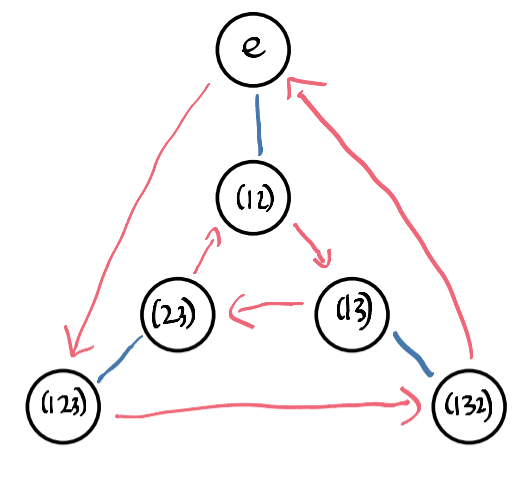
Compute the action of the inner automorphism \(\phi_{(123)}\) on \(S_3\isom D_3\text{.}\) Draw three Cayley diagrams of \(S_3\) to illustrate this action: one the Cayley diagram of the original group with generators \((123)\) and \((12)\text{,}\) one the β€œrelabeling” by \(\phi_{(123)}\) of the first diagram, and one the β€œrewiring” by \(\phi_{(123)}\) of the first diagram.
Solution.
It suffices to compute the images of a generating set of \(S_3\text{,}\) e.g. \((123)\) and \((12)\text{.}\) We have
\begin{equation*} \phi_{(123)}((123))=(123) \quad \phi_{(123)}((12))=(23)\text{.} \end{equation*}
So we get the three Cayley diagrams below.
Cayley diagram of S_3 with generators (123), (12)
Figure 65. Cayley diagrams for \(S_3\) with generators \((123), (12)\)
Relabeled diagram fixing the rotations and rotating the reflections clockwise
Figure 66. Relabeling of the Cayley diagram under the action of \(\phi_{(123)}\)
Rewired diagram fixing the actions of the red arrows and rotating the actions of the blue arrows counterclockwise
Figure 67. Rewiring of the Cayley diagram under the action of \(\phi_{(123)}\)

4.

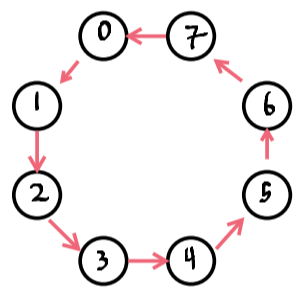
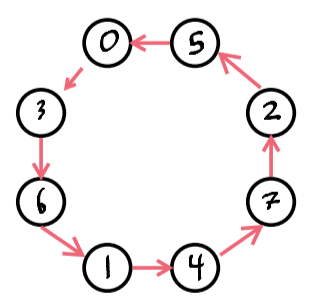
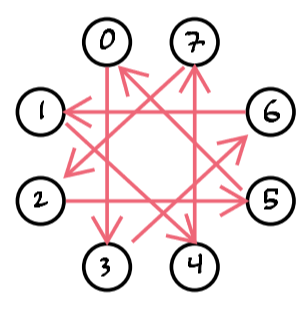
While \(\Inn(\Z_{8})=\{e\}\) is trivial, the full automorphism group of \(\Z_8\) is not. One such automorphism is the map \(\phi(x)=3x \pmod 8\text{.}\) Draw three Cayley diagrams of \(\Z_8\) to illustrate the action of this automorphism: one the Cayley diagram of the original group with generator \(1\text{,}\) one the β€œrelabeling” by \(\phi\) of the first diagram, and one the β€œrewiring” by \(\phi\) of the first diagram.
Solution.
It suffices to compute the images of a generating set of \(\Z_8\text{,}\) e.g. \(1\text{.}\) We have
\begin{equation*} \phi(1)=3\text{.} \end{equation*}
So we get the three Cayley diagrams below.
Cayley diagram of Z_8 with generator 1
Figure 68. Cayley diagram for \(\Z_8\) with generator \(1\)
Relabeled diagram permuting the cycle by taking its third power
Figure 69. Relabeling of the Cayley diagram under the action of \(\phi\)
Rewired diagram adjusting the arrows to point three places around the circle instead of one
Figure 70. Rewiring of the Cayley diagram under the action of \(\phi\)